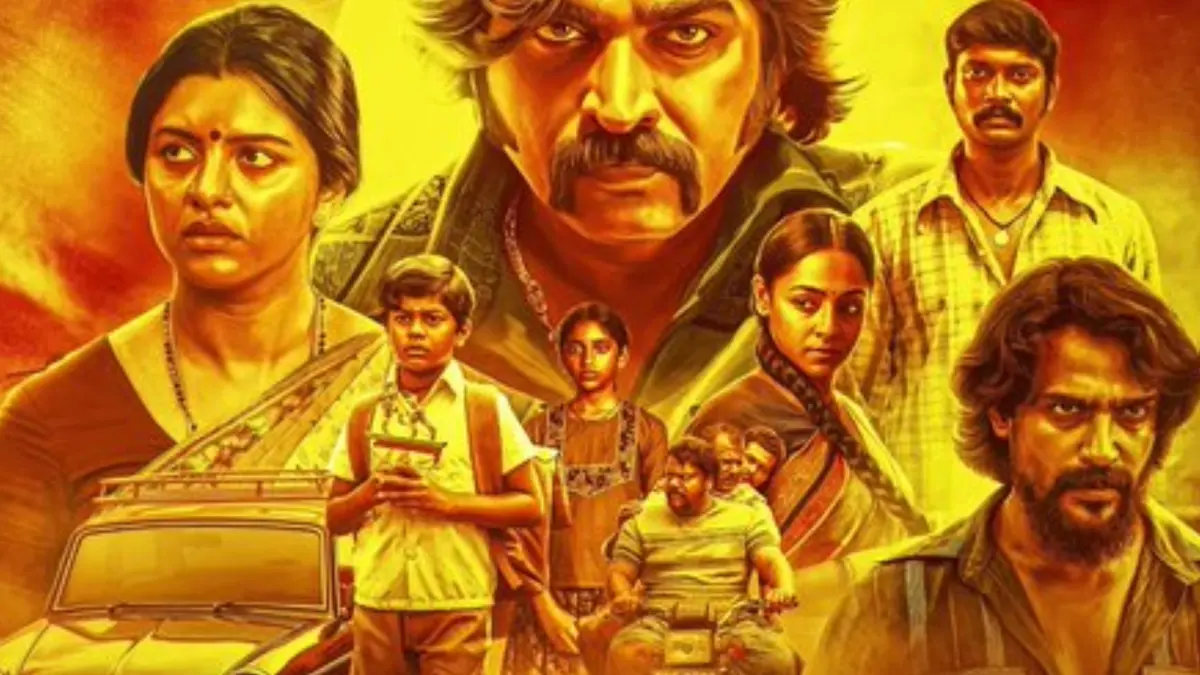
Vijay Sethupathi and director Balaji Tharaneetharan's Baththa arrived in theatres on October 1, offering a gangster story that gradually moves away from violence and power to explore trauma, vulnerability and human transformation.
Set in 1986 Madras, the film centres on Baththa, a feared local gangster whose intimidating personality hides a deeply wounded man.
What begins as a story about a ruthless ruffian eventually turns into an emotional human drama about confronting the past and rediscovering one's softer side.
Vijay Sethupathi Brings Baththa to Life
Vijay Sethupathi plays Baththa, a loud, aggressive and feared local gangster. On the outside, he is everything people expect from a neighbourhood don. At home, however, another side of him emerges.
Baththa deeply loves his daughter Thenmozhi, played by Sahasra Shree, and his wife Kanimaa, played by Lijomol Jose. Although his affection for his family is genuine, his short temper often affects his domestic life.
The film uses this contrast effectively to present Baththa as more than a conventional gangster.
A Schoolboy Changes the Story
The narrative takes an unexpected turn through Sabari, a timid third-standard student played by Sai Prithviraj.
Sabari has heard rumours that Baththa keeps a live lion in a cage on his terrace and feeds it every night. Terrified of the gangster, the young boy sees him as almost a monster.
Things change when Sabari accidentally locks Baththa inside a school restroom. With the school located in an isolated area and no one around to help, Baththa finds himself trapped.
The situation initially creates a black-comedy setup. A man who normally commands fear and authority is suddenly powerless, struggling with hunger, loneliness and basic human needs inside a cramped restroom.
An Unlikely Bond
As Sabari realises what has happened, the film takes a more emotional direction. Instead of turning the incident into a conventional revenge story, Baththa develops an unusual relationship between the frightened schoolboy and the trapped gangster.
Their conversations slowly reveal another side of Baththa.
Without his weapons, influence or intimidating image, Baththa is forced to confront the vulnerabilities hidden beneath his violent persona. Sabari's innocence and lack of judgement gradually become a mirror through which Baththa begins looking at himself.
The film reveals that Baththa was severely bullied during his own school days. His violent adult identity was, in many ways, a protective shell built around those unresolved childhood wounds.
Baththa's Transformation
The restroom becomes more than just a physical prison for Baththa. It becomes a space where he is stripped of the identity he has built for himself.
His interactions with Sabari lead him towards an emotional reckoning with his past. When Sabari eventually confesses what he has done and opens up about his own fears, Baththa responds with unexpected understanding.
That moment becomes an important turning point in the character's journey.
Rather than portraying transformation as an overnight change, the film presents Baththa's experience as a gradual emotional breakdown of the persona he has carried for years.
Vijay Sethupathi and Sai Prithviraj Drive the Film
Vijay Sethupathi carries much of the film through Baththa's contrasting shades. His performance moves between aggression, humour, vulnerability and quiet emotion without losing the character's intimidating presence.
Sai Prithviraj also makes an impression as Sabari. His portrayal of a frightened yet curious child gives the film its emotional centre and allows the relationship between the two characters to develop naturally.
Lijomol Jose and Sahasra Shree add another dimension to Baththa's family life, showing the people behind the gangster's public image.
A Moving Final Act
By the time Baththa is finally released, the experience has changed him. The gangster who once lived through anger and fear begins to rediscover the innocence he had buried long ago.
His changed behaviour towards his wife and daughter gives the film an emotionally satisfying conclusion. The song 'Chella Magale' underlines the transformation and adds further weight to the closing portions.
Sai Abhyankar's music works well with the story's emotional progression, particularly during the film's quieter moments.
Verdict
Baththa starts with the familiar ingredients of a gangster drama but gradually evolves into something more intimate. Its most interesting idea is that another gangster or external enemy doesn't defeat the feared gangster; instead, he's forced to confront the person he once was.
Balaji Tharaneetharan uses the unusual relationship between a schoolboy and a trapped gangster to explore childhood trauma, fear, family and redemption.
At its core, Baththa is less about a gangster's rise or fall and more about the gradual dismantling of the man behind him.