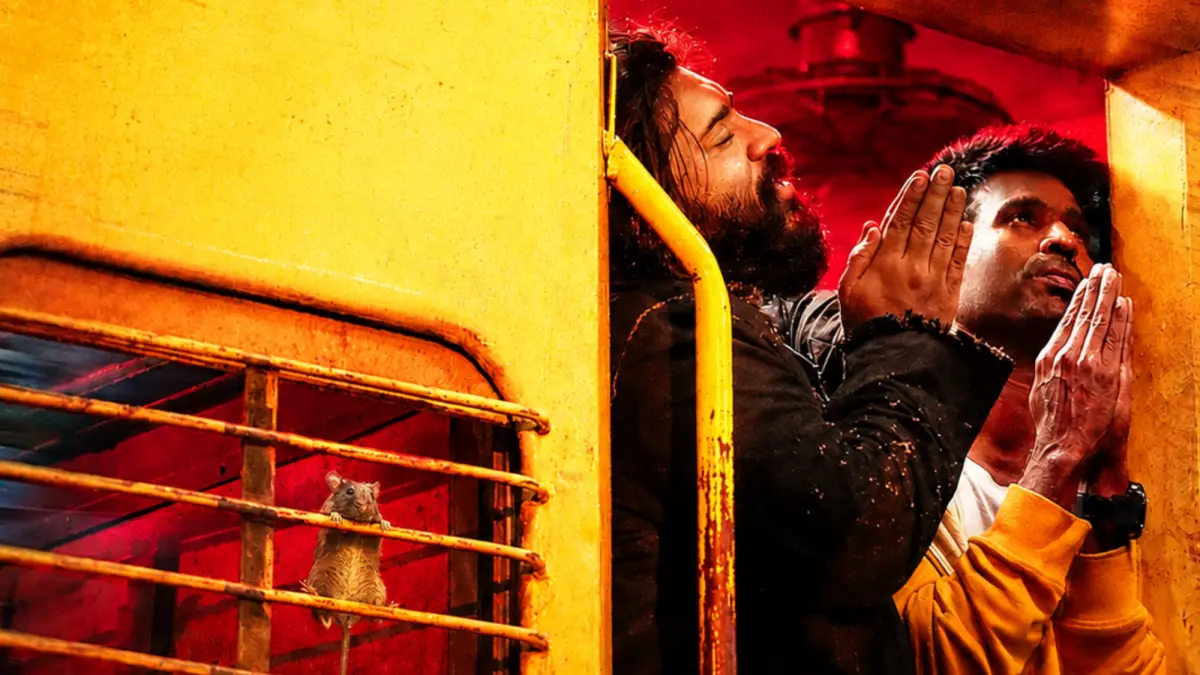
Director Ram returns with Yezhu Kadal Yezhu Malai, an unusual philosophical drama starring Nivin Pauly, Soori and Anjali, released on October 1.
The film brings together two men living completely different lives, one who has existed for nearly 8,000 years and another who is simply trying to reconnect with his family after years away.
The Two Central Characters
Nivin Pauly plays an immortal man who has spent thousands of years searching for the woman he loves. His journey spans different eras, giving the character a mysterious, philosophical quality.
In contrast, Soori plays a man who returns from abroad after eight years and eagerly looks forward to seeing his family and meeting his son.
Their lives unexpectedly collide during a train journey, setting off a series of conversations, arguments, and incidents that form the film's central narrative.
The contrast between the two characters becomes one of the film's most interesting elements. One has witnessed humanity for thousands of years, while the other grapples with the familiar emotions and struggles of ordinary life.
Soori's Role
Soori brings humour to the film, particularly through his excitement about returning to his family. His character provides a lighter side to the otherwise philosophical narrative.
Nivin Pauly's Role
Nivin Pauly, meanwhile, carries a more intense presence, with his character often challenging Soori's understanding of human life and its value.
Philosophical Themes
One of the film's recurring ideas is the relationship between humans and animals, represented through a rat that appears repeatedly throughout the story.
The film deliberately places human and animal life side by side, using the rat as a recurring symbol. Nivin Pauly's character strongly questions the idea that human life should automatically be considered more valuable than an animal's life, adding another philosophical layer to the narrative.
Nivin's dialogues are another distinctive aspect of the film. His character speaks in a style influenced by ancient language and ideas, making his conversations feel different from the usual dialogue-driven drama.
Some of his observations, particularly in the second half, carry a deeper message that extends beyond the characters and directly connects with the audience.
Supporting Performance
Anjali's character adds another dimension to the story and anchors the narrative's emotional side. However, her presence does not create the same impact as the two male leads.
Visuals and Music
Visually, Yezhu Kadal Yezhu Malai is one of the film's strongest aspects. Cinematographer N.K. Ekambaram captures the Western Ghats and Dhanushkodi with striking beauty. The landscapes give the film a magical atmosphere and complement Ram's unusual storytelling approach.
Yuvan Shankar Raja's music also fits the film's mood. Rather than overpowering the narrative, the music blends into the situations and strengthens several of the film's emotional and dramatic moments.
Overall Verdict
At its core, Yezhu Kadal Yezhu Malai follows two men living completely different lives. One has thousands of years behind him and continues to search for his lost love, while the other is trying to find his place within his family after being away for eight years.
Ram once again chooses a narrative that does not follow a conventional path. His writing combines philosophy, humour, love and human relationships, using the train journey as the space where these contrasting lives come together.
The film ultimately leaves two important questions at the centre of its story: Will Soori's character reunite with his family and meet his son as he hopes? And will the immortal man finally find the love he has been searching for across different eras? The answers form the emotional core of this unusual journey.