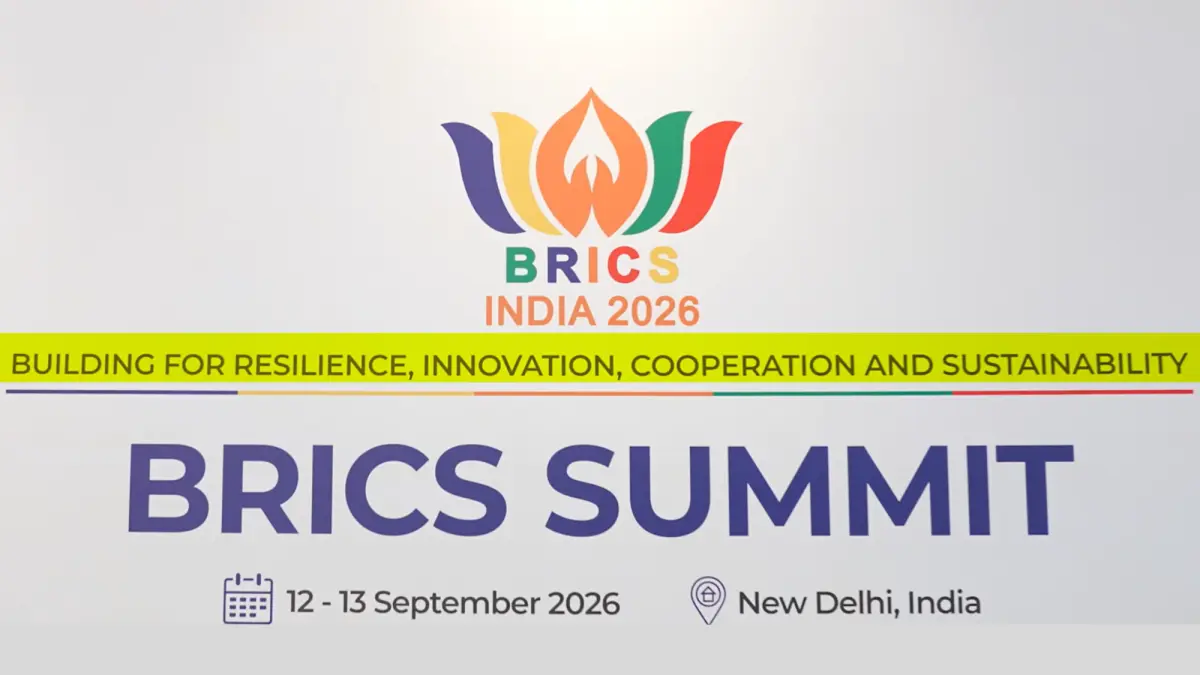
New Delhi is preparing to host one of the year's biggest diplomatic gatherings as BRICS leaders arrive for the 18th BRICS Leaders' Summit.
India, which holds the BRICS chairmanship in 2026, will host the leaders' summit at Bharat Mandapam in New Delhi on September 12 and 13, 2026.
The wider programme, including the BRICS Business Forum and summit-related arrangements, runs from September 11 to 13.
The summit comes at a time of major change in the global economy and international politics.
Conflicts, trade tensions, energy-security concerns, supply chain disruptions, climate challenges and the growing importance of new technologies have made cooperation among developing and emerging economies increasingly important.
For India, the summit is also an opportunity to place the concerns of the Global South at the centre of international discussions.
The summit is being hosted under the central theme "Building for Resilience, Innovation, Cooperation and Sustainability" anchored in a "Humanity First" approach.
Delegations and prominent world leaders, including Russian President Vladimir Putin, arrived on September 11.
This marks his first in-person participation at a BRICS summit outside Russia since the start of the war in Ukraine in 2022.
Chinese President Xi Jinping is scheduled to arrive on September 12, as world leaders convene in the national capital, bringing global attention to New Delhi for crucial multilateral dialogues.
The event is generating major international interest as it marks the first major gathering of the newly expanded bloc, which now includes 11 full members: Brazil, Russia, India, China, South Africa, Egypt, Ethiopia, Indonesia, Iran, Saudi Arabia, and the United Arab Emirates.
Key Summit Schedule
September 11
High-stakes bilateral interactions are underway. Prime Minister Narendra Modi is holding independent sideline meetings on Friday with Russian President Vladimir Putin and Iranian President Masoud Pezeshkian.
September 12
The summit officially opens with a closed-door session for core member countries titled "Inclusive Global Governance and Strengthening Multilateralism".
Leaders will also tour the Bharat Innovates Exhibition and hold a joint tree-planting ceremony, concluding with a grand Gala Dinner hosted by PM Modi featuring a "BRICS Symphony" performance.
September 13
Expanded sessions will include designated partner countries and outreach invitees.
The event will formally close following the joint ratification and release of the official New Delhi Declarations.
Core Strategic Agenda
Multilateral Reform
Promoting a unified voice for the Global South by advocating for urgent systemic overhauls inside the UN, IMF, and World Bank.
Financial De-Dollarisation
Expanding mechanisms to facilitate intra-bloc trade directly through national local currencies to bypass Western economic sanctions and dependencies.
Middle East Security And Diplomacy
Finding a cohesive diplomatic stance on ongoing Middle East crises to balance varying internal viewpoints between newly admitted members like Iran and the UAE.
Critical Resources
Crafting shared framework policies targeting international supply chains. Food security, energy transitions and green finance.
Institutions That Are Closed
During the 18th BRICS Summit, New Delhi is not under a complete shutdown, but a public holiday has been declared on September 11, 2026.
All government, government-aided, and private schools under the Delhi Directorate of Education are strictly closed on Friday, September 11. Regular physical classes will resume on Monday, September 14.
All central government offices, Delhi state government administrative offices, autonomous bodies, and public sector undertakings (PSUs) are closed on September 11.
Specific venues, such as the Delhi Metro Museum at the Supreme Court Metro Station, will remain closed from September 11 to 13.
Institutions That Remain Operational
Commercial businesses and private corporate offices remain open. However, employers are advised to consider remote work options due to extensive VVIP motorcade movement.
Banks and the National/Bombay Stock Markets continue normal operations on Friday.
The Delhi Metro remains fully active across its lines, operating on slightly adjusted early-morning schedules to keep the public moving smoothly around road closures.
Grocery stores, pharmacies, restaurants, tourist locations, and essential medical delivery entities remain open, subject only to security barricades in central VVIP zones.
Traffic Restrictions And Controlled Zones
Over 15,000 police and paramilitary personnel have been deployed to fortify the city, with a primary focus on the summit venue, VVIP transit routes, and delegate hotels.
To reduce public inconvenience, the central government has introduced a rare simplified protocol; union ministers and state chief ministers are bypassing individual high-security motorcades and travelling together in shared buses from Parliament to the venue.
Stringent traffic curbs and checkpoint diversions are strictly active daily between 02:00 PM and 08:30 PM.
A designated "controlled area" spans major pockets of Central and South Delhi.
More than 35 major arterial roads are experiencing temporary blockages and diversions during VVIP movements.
Heavily affected routes include Mathura Road, Sardar Patel Marg, Shanti Path, Janpath, Ashoka Road, Barakhamba Road, Tolstoy Marg, and APJ Abdul Kalam Road.
The Delhi Traffic Police have established 22 specific diversion points to reroute standard vehicles away from secure VIP corridors.
The 2026 BRICS Summit arrives at an important point in the group's development.
From four founding countries, BRICS has grown into an 11-member grouping with an additional network of partner countries.
India's challenge now is to show that a larger BRICS can still make decisions and deliver practical cooperation despite differences among its members.
The summit is both a diplomatic event and a statement of India's growing role in international affairs.
For the BRICS countries, it is a chance to discuss economic opportunities, development, and global challenges from the perspective of emerging and developing economies.