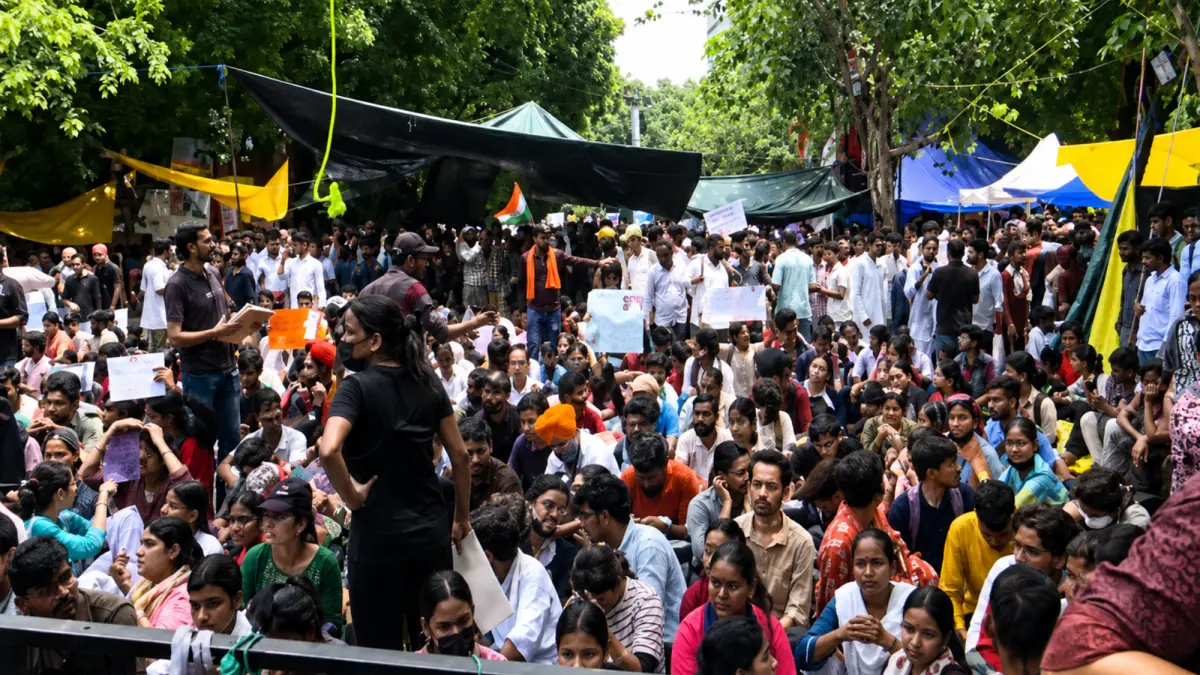
India is witnessing one of its largest youth-led movements in recent years.
What began as anger over examination paper leaks has evolved into a nationwide movement demanding accountability, transparency in recruitment and education, and the resignation of Union Education Minister Dharmendra Pradhan.
Key Parliamentary Events
During the Monsoon Session of Parliament, both houses were repeatedly adjourned and shut down as the opposition staged massive protests in solidarity with the youth-led Cockroach Janta Party (CJP).
The opposition bloc, specifically the I.N.D.I.A. alliance, led by Mallikarjun Kharge, insisted that Union Education Minister Dharmendra Pradhan must resign immediately.
They declared his resignation a non-negotiable prerequisite before any discussion on the NEET-UG paper leak could begin.
Opposition leaders demanded an immediate suspension of regular business to debate the exam scandal under Rule 267.
The Deputy Chairman resisted, citing that the rule is meant for the 'rarest of rare' occasions, to which Kharge fiercely replied that the systematic collapse of youth examinations fits that exact description.
Lawmakers fiercely confronted the ruling party over the 'brutality unleashed' on students.
They cited the recent 'Chalo Sansad' march where police used batons and tear gas on teenage protesters.
While Union Ministers Kiren Rijiju and J.P. Nadda stated that the government was ready for a full debate on NEET, the treasury benches erupted into shouting matches that forced successive house adjournments.
Amid the chaotic atmosphere, the Trinamool Congress (TMC) MP Kalyan Banerjee was suspended for the remainder of the Monsoon Session.
Following an initial adjournment, he was accused of using 'unsavoury language' against women MPs during a heated exchange inside the chambers.
Tear Gas And Chaos
Security forces deployed tear gas and baton charges to control tens of thousands of student demonstrators demanding education reforms.
Flashpoint 1: The 'Chalo Sansad' March (Monday, July 20, 2026)
Over 20,000 youth protestors attempted an unauthorised march from Jantar Mantar toward the Parliament building during the first day of the monsoon session.
Around 11:25 AM, the massive crowd attempted to push through multiple security barricades in the high-security New Delhi Zone.
As a scuffle broke out, the Delhi Police and Parliamentary forces retaliated by firing successive rounds of tear gas shells and executing a heavy baton charge (lathi-charge) to disperse the crowd.
The entire area immediately fell into utter chaos, worsened by a preemptive mobile internet shutdown in Central Delhi.
More than 60 protestors were wounded, and the CJP alleged that even women, children and Gitanjali Angmo (activist Sonam Wangchuk's wife) were caught in the police aggression.
Police reported that 118 of their personnel were also injured during the day's chaos.
Flashpoint 2: Late Night Tolstoy Marg Clashes (Wednesday, July 22, 2026)
The situation escalated drastically again around 8:30 PM near Tolstoy Marg and Jantar Mantar in Connaught Place.
After the crowd swelled past 10,000 people and spilt over into adjoining roads, a segment of the protest allegedly turned aggressive.
Delhi Police stated that miscreants began pelting stones and plastic bottles at security cordons, prompting the Rapid Action Force (RAF) to intervene.
The RAF fired multiple rounds of tear gas and launched a fresh cane-charge to clear out the intersection.
Six police officials, including two Assistant Commissioners of Police (ACPs), were rushed to the hospital with severe injuries.
Internet jammers were actively deployed at Jantar Mantar following the midnight clearance.
Public And Media Reactions
The tear gas deployment has drawn sharp criticism across social media, where Gen-Z protestors ironically shared videos of the security crackdown alongside memes.
Opposition parties strongly condemned the government's use of force on students, which later triggered massive disruptions and suspensions inside Parliament.
The Prime Minister's Stance
Prime Minister Narendra Modi broke his silence on the NEET-UG 2026 paper leak scandal, directly addressing the youth protests through both direct messages to his lawmakers and a public announcement on social media.
Speaking behind closed doors at the National Democratic Alliance (NDA) parliamentary party meeting, Modi termed the paper leaks a 'grave sin' and emphasised that ensuring leak-free examinations is a 'national responsibility' that should not be weaponised for party politics.
He instructed NDA lawmakers to proactively reach out to the youth, guide them through their frustrations, and assure them that safeguarding the future of students is the government's topmost priority.
Modi defended his administration's initial handling of the crisis, stating that the government acted immediately by involving the CBI, arresting 13 key suspects, and prioritising a timely NEET re-examination so that honest students would not suffer prolonged delays.
The PM's Tweet: 'Those Who Harm Our Youth Will Not Be Spared'
The Prime Minister took to his official handle on X on the morning of July 23, 2026, to make his first direct public intervention regarding the exam crisis.
"Nothing is more important than the welfare and future of our youth!
We have decided to set up fast-track courts to ensure swift and stringent punishment for those involved in paper leaks. Have directed the concerned authorities and officials to take all necessary steps in this regard. This continues our series of steps for safeguarding the interests of students.
Those who try to harm the future of our youth will not be spared." He declared.
The CJP's Response To The Tweet
The Cockroach Janta Party, led by founder Abhijeet Dipke, immediately rejected the Prime Minister's fast-track court initiative.
The organisation issued a sharp, terse response on X, reiterating that the resignation of Education Minister Dharmendra Pradhan is non-negotiable.
Protesters stated that the youth "do not want speeches or fast-track promises; they want an entirely overhauled, secure examination system."
The movement has become one of the of the most significant youth-led mobilisations in recent years, bringing national attention to concerns about examination integrity, public accountability and the future of India's education system.