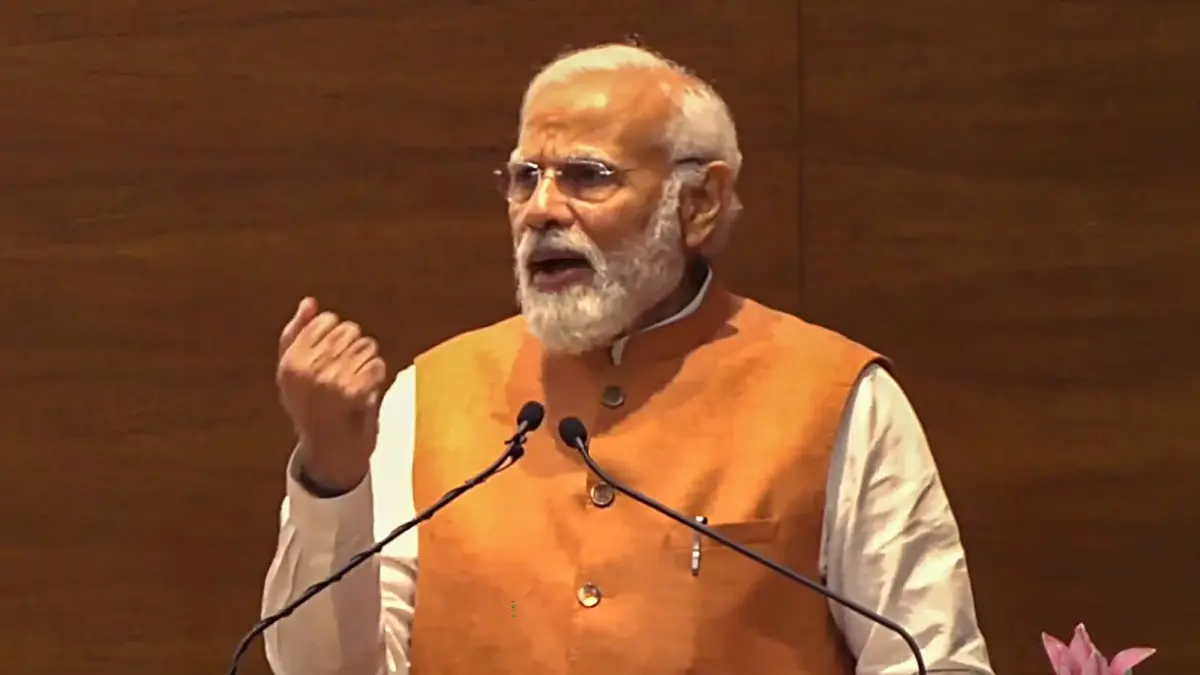
Prime Minister Narendra Modi has completed 25 years as head of government, marking a political journey that began in Gujarat on October 7, 2001, and later took him to the national stage as India's Prime Minister.
The milestone covers more than 12 years as Gujarat's Chief Minister and three consecutive terms as Prime Minister since 2014.
It has also brought a wave of messages from Union Ministers, BJP Leaders, State Leaders, NDA Allies, and political figures from several countries. At the same time, the Union Cabinet formally passed a resolution recognising the occasion.
For Modi himself, however, the anniversary has been presented less as a personal celebration and more as a moment to remember the people, workers, and circumstances that shaped his political journey.
In his remarks, he thanked the public for its trust and linked the next phase of his work to his goal of building a developed India by 2047.
Key Celebrations and Commemorative Events
The Union Cabinet passed a formal resolution congratulating PM Modi and gave him a standing ovation for replacing political entitlement with service and accountability.
Information and Broadcasting Minister Ashwini Vaishnaw highlighted his tenure as a testimony to the strength of Indian democracy.
Central events included the "Seva Jyoti Yatra" torchlight processions led by youth across every district in India.
A grand public event was held at the Indira Gandhi Indoor Stadium in Delhi.
PM Modi began the anniversary by performing an aarti at the Shree Vinayak Temple in Delhi.
Concurrently, booth yatra and a massive biker rally connected his birthplace, Vadnagar, to his parliamentary constituency, Varanasi.
International leaders, including the Prime Ministers of Bhutan, Japan, and Dominica, extended high-level diplomatic congratulations, praising his governance model and bilateral leadership.
At the "Viksit Bharat Sankalp Sabha" in New Delhi, he introduced the national slogan "We Will Do It" to help achieve developed-nation status.
Key Governance Milestones Highlighted
The Union Cabinet resolution officially categorised the legacy of his 25-year tenure into a few defining pillars.
Massive socio-economic transformations, including opening nearly 60 crore Jan Dhan bank accounts, building over 4 crore houses, and lifting 25 crore people out of poverty.
Key policies included implementing the Goods and Services Tax (GST) regime, the Direct Benefit Transfer (DBT) framework, and decriminalising outdated, colonial-era laws.
Public capital expenditure expanded aggressively from ₹2 Lakh crore to over ₹12 Lakh crore, driving a manufacturing boom that pushed domestic electronics production above ₹13 Lakh crore, alongside massive defence production.
Leading the digital payments revolution via the Unified Payments Interface (UPI), producing indigenous COVID-19 vaccines, and achieving the historic Chandrayaan-3 Moon landing.
Landmark decisions like the abrogation of Article 370 in Jammu and Kashmir, swift crisis management during the pandemic, and building global consensus as a leading voice for the Global South at the G20 and BRICS summits.
As Modi looks beyond the 25-year milestone, his central political message remains tied to the goal of a developed India by 2047.
The government has spoken about making India a leading global economy, expanding manufacturing, strengthening infrastructure, increasing technological capabilities, and creating opportunities for young Indians.