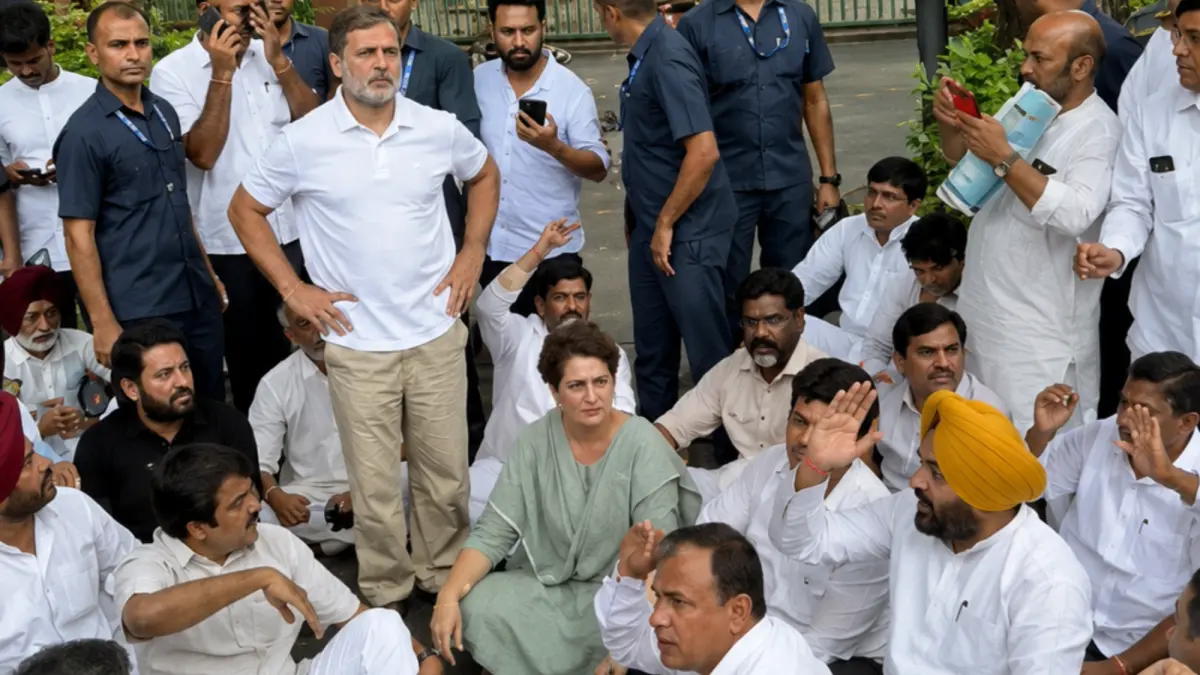
Why Did The Protest Take Place?
The protest is part of a broader nationwide movement over allegations of irregularities in the NEET examination system and growing anger among students over repeated exam-related controversies.
Student groups, along with the youth-led Cockroach Janta Praty (CJP) movement, have accused the government of failing to protect the integrity of competitive examinations. Protesters have demanded:
The resignation of Union Education Minister Dharmendra Pradhan.
A transparent investigation into alleged examination irregularities.
Comprehensive reforms in India's examination system.
Justice for students affected by the controversies.
Accountability for police action against student demonstrators.
Opposition Leaders Protest
The protest outside Prime Minister Narendra Modi's residence at 7, Lok Kalyan Marg was a unified opposition demonstration.
It featured top national political leaders, members of Parliament (MPs), and key leaders.
Senior Congress Leaders And Opposition Allies
The Leader of the Opposition (LoP) in the Lok Sabha, Rahul Gandhi, organised and led the surprise march to the PM's residence.
Congress General Secretary Priyanka Gandhi Vadra marched and stayed with the group until being detained.
The National President of Congress, Mallikarjun Kharge, co-led the initial march from his residence at Rajaji Marg.
Akhilesh Yadav, Samajwadi Party (SP) Chief and former Chief Minister of Uttar Pradesh, joined the core sit-in and was detained in the same police bus as Rahul Gandhi.
Supriya Sule, a senior leader of the Nationalist Congress Party (Sharadchandra Pawar), or NCP(SP), arrived later to bolster the sit-in.
Other Participants
Several senior MPs from the Congress party and various regional allies joined the frontline, raising slogans against the government over the NEET paper leak and student safety.
The Timeline Of Events
The leaders began their surprise march and subsequent sit-in (dharna) near the Prime Minister's residence at approximately 03:30 PM.
After failed negotiations with Union government representatives, the police and Rapid Action Force (RAF) forcibly cleared the site and took the leaders into custody at around 6:30 PM.
Both Congress Leaders were detained for nearly 3 to 3.5 hours before being released on the same night.
Priyanka Gandhi Vadra was held at the Mandi Marg Police Station and released at 09:45 PM.
The Senior Congress Leader Sonia Gandhi visited Priyanka Gandhi Vadra during the detention and expressed solidarity with the other detained leaders.
She spent time inside the station with the other detained members.
Priyanka Gandhi was not alone inside the station; senior Congress leaders like Deepender Singh Hooda and Supriya Shrinate were detained alongside her at the same location.
A massive crowd of Congress party workers, youth activists, and supporters quickly gathered outside the Mandir Marg Police Station.
They staged a loud demonstration on the streets, demanding the immediate release of Priyanka Gandhi and her colleagues until they were finally freed.
Rahul Gandhi was held at Chhatrasal Stadium and released shortly after, at around 10:00 PM.
Akhilesh Yadav, the chief of the Samajwadi Party (SP), was the most prominent national leader taken alongside Rahul Gandhi to Chhatrasal Stadium.
They were joined by several other senior opposition Members of Parliament and party leaders.
Other senior leaders who joined the protest, such as Karnataka Chief Minister DK Shivakumar and Kerala Leader of the Opposition VD Satheesan, were taken to a separate detention facility at Kingsway Camp.
Rahul Gandhi did not receive any high-profile political visitors while held at Chhatrasal Stadium.
While no leaders went inside to meet him, a massive crowd of Congress workers, youth activists, and supporters blocked the streets outside Chhatrasal Stadium.
They staged a fierce demonstration for his release until he was finally let go later that night.
Though there were some restrictions inside the stadium, Gandhi remained actively online, recording and releasing a video statement directly to the public that outlined his five core demands to the Central Government.
Seeing the escalating situation outside 7, Lok Kalyan Marg, the Central Government deputed Jitendra Singh, the Minister of State in the Prime Minister's Office (PMO), along with the Union Home Secretary Govind Mohan, to negotiate directly with Rahul Gandhi.
Minister Jitendra Singh urged Gandhi to end the sit-in. According to government officials, Rahul Gandhi initially agreed to call off the protest if the Centre formally guaranteed a full-fledged debate on the NEET paper leak issue inside Parliament. The government accepted this demand.
He then also accused Gandhi of backstabbing and suddenly adding a new non-negotiable condition: the immediate resignation of Union Education Minister Dharmendra Pradhan.
The BJP minister claimed Gandhi was simply in a 'mood for conflict' rather than discussion.
Because the opposition refused to budge on Pradhan's resignation, the negotiation collapsed completely.
Rahul Gandhi's Demands
After his release, Rahul Gandhi reiterated five key demands before the Central Government
An official apology from Prime Minister Narendra Modi to the student community.
The immediate resignation of Union Education Minister Dharmendra Pradhan.
The resignation of Union Home Minister Amit Shah over the police crackdown.
A complete overhaul and reform of the national examination system.
Financial compensation for the families of students affected by the paper leak crisis.
Shift To Parliament: The 'Black Day' Protest
On Wednesday morning, Leader of the Opposition Rahul Gandhi, along with Priyanka Gandhi Vadra, Akhilesh Yadav, Mahua Moitra, and other senior alliance MPs, arrived at Parliament dressed entirely in black.
They gathered at the Makar Dwar entrance of Parliament, staging a high-profile demonstration while holding placards and raising slogans demanding the immediate resignation of Education Minister Dharmendra Pradhan.
Ongoing Agitation
On the ground, the street protest has not ended; it has simply moved away from the Prime Minister's residence.
Thousands of youth activists and students have returned to Jantar Mantar in New Delhi to continue the agitation.
Senior opposition leaders who were not detained yesterday, such as Congress MP Shashi Tharoor, have been arriving at Jantar Mantar to show solidarity with the continuing student-led movement.
The Government's Current Stance
Union Education Minister Dharmendra Pradhan and central government sources stated that the Centre is fully prepared for a structured discussion on the NEET issue in Parliament.
The BJP has fiercely hit back at Rahul Gandhi, accusing the Congress of "politicising" the student crisis and prioritising a "political spectacle" over actual legislative dialogue.
Prime Minister Modi has reportedly called the paper leak a grave sin (ghor paap) but maintains that the opposition's resignation demands are purely politically motivated.
Student organisations have said they will continue demonstrations until concrete action is taken.
Congress has indicated it will keep raising the issue in Parliament and through public protests.
At the same time, the government continues to defend its handling of the matter and rejects allegations that it is ignoring students' concerns.