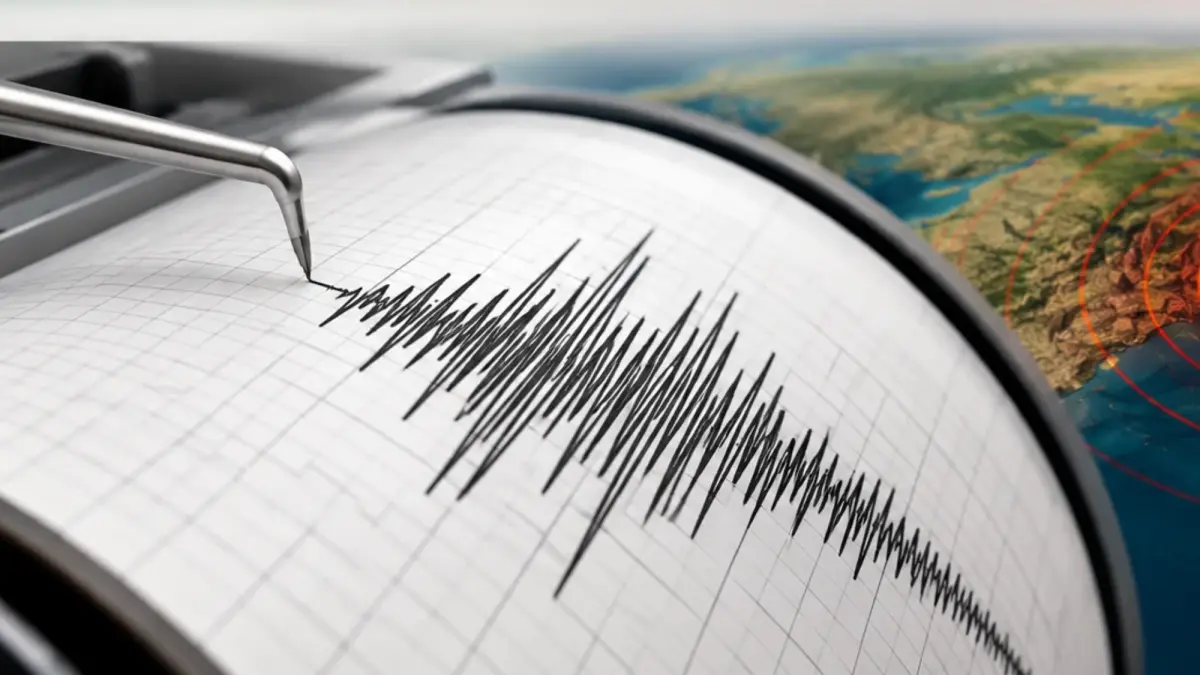
A moderate earthquake of magnitude 4.1 reportedly struck Shimla, with tremors felt in the Rampur area, about 130 km from Himachal Pradesh, around 4 am on Saturday, October 17, 2026.
Shimla Earthquake details
Earthquakes are relatively common in the Himalayan region because it lies in a seismically active zone where tectonic plates interact. The region is vulnerable to seismic activity, making earthquake preparedness and public awareness particularly important.
On October 17, Shimla was reportedly struck by a moderate earthquake early in the morning around 4 am. According to the National Centre for Seismology, the earthquake measured 4.1 on the Richter scale.
It is also claimed that the earthquake's depth in Shimla was recorded at 10 kilometres.
The tremor was located at latitude 31.298° North and longitude 77.529° East, approximately 24 kilometres from Rohru in Shimla district.
It is reported that there was no structural damage or casualties. As the place was hit by a moderate earthquake, it avoided heavy property damage and loss of life.
The last tremor comes amid a series of seismic events reported across northern India in recent weeks. Earlier this month, on October 6, a magnitude 4.9 earthquake struck Uttarakhand's Chamoli district, raising further attention to seismic activity in the Himalayan region.
Why did the earthquake happen in Shimla?
The frequent earthquakes are measured in the state due to the state capital and the surrounding Shimla district sitting in the highly active Seismic Zone IV; the region experiences regular tectonic activity.
Over the last few years alone, Shimla and the broader Himachal Pradesh region have recorded dozens of minor to moderate tremors.
Shimla's Historical Earthquakes
Just months prior, on August 26, 2026, a shallow magnitude 4.0 tremor similarly shook Shimla and neighbouring Chamba.
These events follow a long pattern of smaller, routine background seismic shifts within the district, such as a magnitude 2.8 quake on October 22, 2025, and a magnitude 3.0 quake on October 12, 2024, none of which resulted in significant structural damage or casualties.
While Shimla itself has mostly avoided being the direct epicentre of catastrophic modern disasters, the city has historically experienced violent shaking from massive earthquakes centred nearby in the Himalayas.
The most devastating of these was the historic 1905 Kangra earthquake, a massive magnitude 7.8 disaster that killed over 20,000 people and flattened entire towns across Himachal Pradesh, sending severe shockwaves directly through Shimla.
Decades later, the 1975 Kinnaur earthquake, a powerful magnitude 6.8 quake, struck the neighbouring district, causing widespread landslides and damage that reverberated strongly across the capital.
No casualties recorded yet.