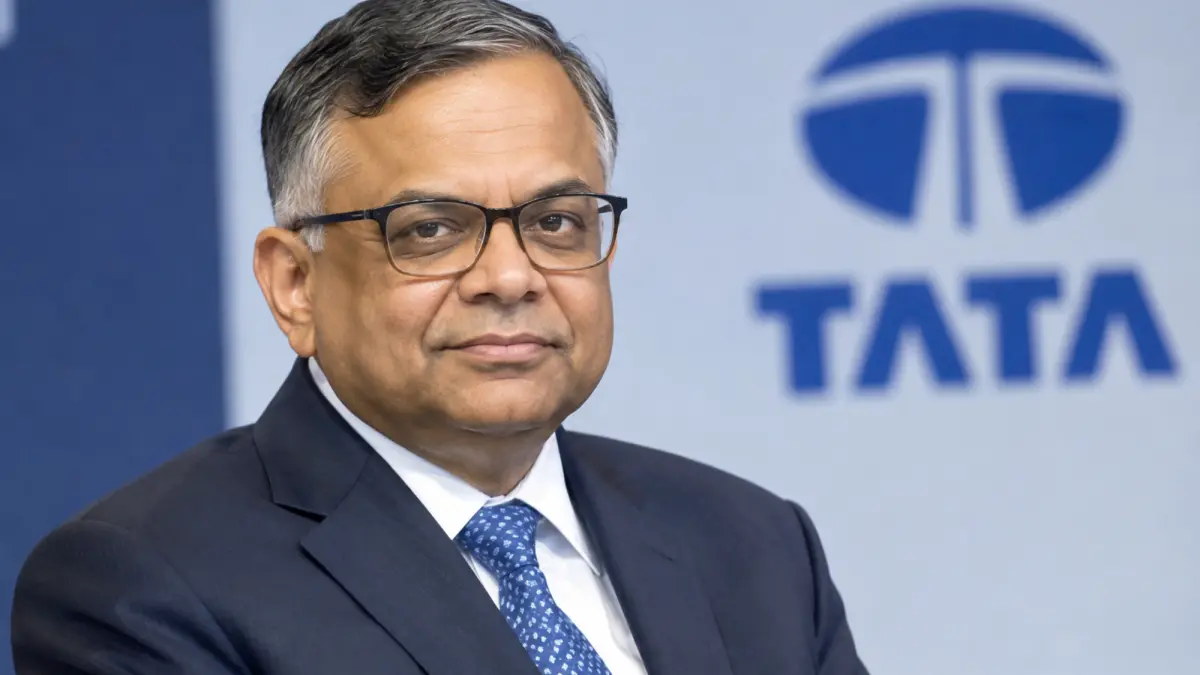
The Tata Group's leadership transition has taken an unexpected turn.
Tata Sons, the holding company at the centre of the sprawling Tata Group, has backed N. Chandrasekaran for another five-year term as executive chairman, reversing a succession process that appeared to be moving toward a new leader.
The Tata Sons board's decision on September 17, 2026, comes only weeks after Chandrasekaran said he would not seek another term when his existing tenure ends on February 20, 2027.
The board's latest move therefore changes the direction of the succession process and puts Chandrasekaran back at the centre of the Tata Group's leadership plans.
The decision, however, was not unanimous.
Noel Tata, chairman of Tata Trusts and a nominee director on the Tata Sons board, opposed Chandrasekaran's reappointment.
Tata Trusts subsequently challenged the board decision, arguing that the Tata Sons Articles of Association require a majority of Tata Trusts' nominee directors to support it.
That means the announcement is not necessarily the final word on who will lead Tata Sons after February 2027.
The question could now move to the company's shareholders and the next annual general meeting.
About N. Chandrasekaran
Natarajan Chandrasekaran is a long-time Tata executive who rose through the group's technology business before becoming the head of Tata Sons.
He joined Tata Consultancy Services in 1987 and eventually became its chief executive and managing director in 2009.
He remained TCS chief until 2017, when he was appointed executive chairman of Tata Sons.
He had joined the Tata Sons board in October 2016, shortly before becoming chairman.
His 2017 appointment was based largely on his record at TCS.
At the time, Tata Sons said he had demonstrated strong leadership as TCS chief and that the board believed he could help the wider Tata Group realise its potential while preserving its values and ethical standards.
Since becoming chairman, Chandrasekaran has been associated with the group's efforts to coordinate its businesses more closely and pursue larger investments in new areas.
Tata's own profile describes his approach as the 'One Tata' strategy, built around simplification, scale and synergy.
His tenure has also included major strategic development, including the Tata Group's return to the aviation business through its acquisition of Air India and expansion into areas such as semiconductors, electronics manufacturing and digital businesses.
Why The Sudden Shift?
Regulatory pressure has forced Tata Sons to prepare for a public stock market listing (IPO), prompting an immediate re-evaluation of leadership needs.
The RBI's Definite Directive (The Main Trigger)
Tata Sons has fiercely fought to remain a privately held company.
To avoid a mandatory public listing under the RBI's Upper-Layer Non-Banking Financial Company (NBFC) rules, Tata Sons aggressively repaid over ₹21,000 crore in debt, hoping it could surrender its NBFC status.
However, on September 11, 2026, the RBI officially rejected Tata Sons' application to surrender its registration.
This rejection abruptly closed the door on an IPO. By law, Tata Sons must now initiate steps to list on the stock exchanges.
The Desperate Need For Institutional Continuity
An IPO for a $300 billion empire like the Tata Group is massive and highly complex.
The board's Nomination and Remuneration Committee realised that going into a historic public listing while also managing a leadership transition would severely spook investors and destabilise the markets.
Global and domestic investors demand absolute management stability before buying into an IPO.
The committee asked Chandrasekaran to reconsider his August resignation.
Given the shifting regulatory path, he agreed to stay to guide the group through the listing process.
High Stakes And Deepening Boardroom Friction
While the majority of the board voted to keep Chandrasekaran for stability, the sudden shift has exposed an intense internal rift.
Noel Tata's Veto
Noel Tata, Chairman of Tata Trusts, which holds a 66% controlling stake, voted against the extension and called the board's vote 'illegal'.
Strategic Disagreements
Noel Tata has historically opposed a public listing because an IPO would subject Tata Sons to immense regulatory scrutiny and could dilute the historic veto powers the philanthropic Tata Trusts hold over the conglomerate.
He has also raised sharp concerns about capital allocation and financial losses in newer ventures like Air India, e-commerce, and semiconductors.
Pressure From The Shapoorji Pallonji (SP) Group
The SP Group, which owns an 18.37% stake in Tata Sons, has long pressured the company to list.
Saddled with heavy debt, a public listing gives the SP Group an official valuation and a clear path to liquidity, unlocking the massive wealth tied up in its Tata Sons shares.
The RBI decision essentially hands them a major corporate victory, heightening the urgency in the boardroom.
The board's decision does not necessarily end the dispute.
Chandrasekaran's continuation will still face the company's shareholder processes, and his position as a director will also become relevant at the Annual General Meeting (AGM).
Tata Trusts' approximately 66% ownership of Tata Sons gives the trusts considerable influence over shareholder decisions.
That makes the next AGM particularly important.
The situation could therefore develop in several stages: the board has backed Chandrasekaran, Tata Trusts has objected to the validity of the board's decision, and shareholders will ultimately have an important role in the next stage of the process.