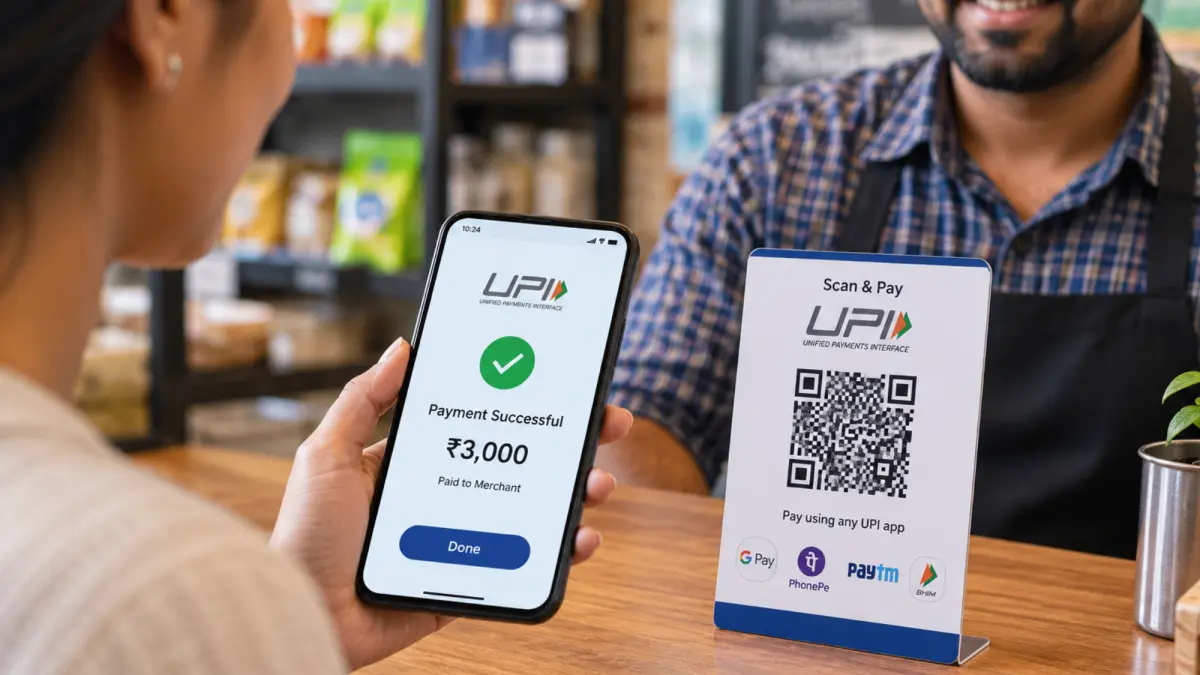
The National Payments Corporation of India (NPCI) has announced a new Merchant Discount Rate (MDR) structure for select UPI transactions above ₹2,000.
The revised charges will come into effect from October 15, with the standard MDR set at 0.4% and capped at ₹300 per transaction.
The new framework will apply to merchant payments, while person-to-person UPI transfers will remain exempt from MDR. Auto-debits and UPI mandates will also continue without MDR charges.
0.4% MDR for UPI Payments Above ₹2,000
Under the revised structure, merchants will be charged 0.4% MDR on eligible UPI transactions above ₹2,000. However, the total MDR will be capped at ₹300, meaning the charge will not increase beyond this limit even for high-value transactions.
The NPCI said more than 95% of UPI merchant transactions are below ₹2,000 and will therefore remain unaffected by the change.
Payments to small merchants, including vegetable vendors and tea shops, will also remain exempt from MDR if their monthly UPI receipts are below ₹1 lakh.
₹5 MDR for Selected Services
A flat MDR of ₹5 will apply to certain eligible transactions above ₹2,000. These include utility payments, fuel purchases, insurance premiums, railway tickets and several government services.
For payments involving mutual funds and stockbrokers, the MDR has been set at 0.02%, subject to an overall cap of ₹300.
Customers Will Not Pay the MDR
The Finance Ministry has clarified that merchants must bear the MDR and should not pass it on to customers.
Banks have been advised to ensure that merchants do not recover the MDR from consumers. UPI application providers have also been prohibited from imposing platform fees or hidden charges on such transactions.
Large retailers, online platforms and restaurants may choose to absorb the additional payment-processing cost. The Finance Ministry noted that businesses already incur costs associated with handling cash, including charges that some banks levy on cash deposits.
How UPI MDR Will Be Distributed
The government clarified that MDR is neither a tax nor a charge collected by the government or NPCI. Instead, the fee is distributed among participants in the payments ecosystem, including banks and payment service providers, to support UPI's operation and expansion.
Under the new structure, 0.28% of the MDR will constitute the interchange component paid by the acquiring bank to the issuing bank. The remaining portion will be distributed within the payment ecosystem, including the payment service provider.
NPCI has also announced a dedicated fund for small merchants, with 5% of MDR collections earmarked for the initiative.
Why UPI MDR Is Being Introduced
NPCI has argued that the government subsidy supporting UPI is short-term, while maintaining the country's rapidly expanding digital payment infrastructure requires significant recurring investment.
According to NPCI, around ₹20,000 crore is required annually to support UPI operations, increase server capacity and strengthen fraud-prevention systems.
Despite introducing MDR for certain high-value merchant transactions, the Finance Ministry said the new UPI charges remain significantly lower than traditional card-payment processing costs. Standard credit-card MDRs typically range from 1.5% to 2.5%, while debit-card MDRs can be capped at up to 0.9%.
The revised framework is therefore expected to introduce a cost for some high-value merchant UPI payments while leaving person-to-person transfers and most everyday UPI transactions outside the MDR structure.
UPI MDR for payments above ₹2,000
MDR is deducted from the merchant's settlement rather than added to the customer's bill.