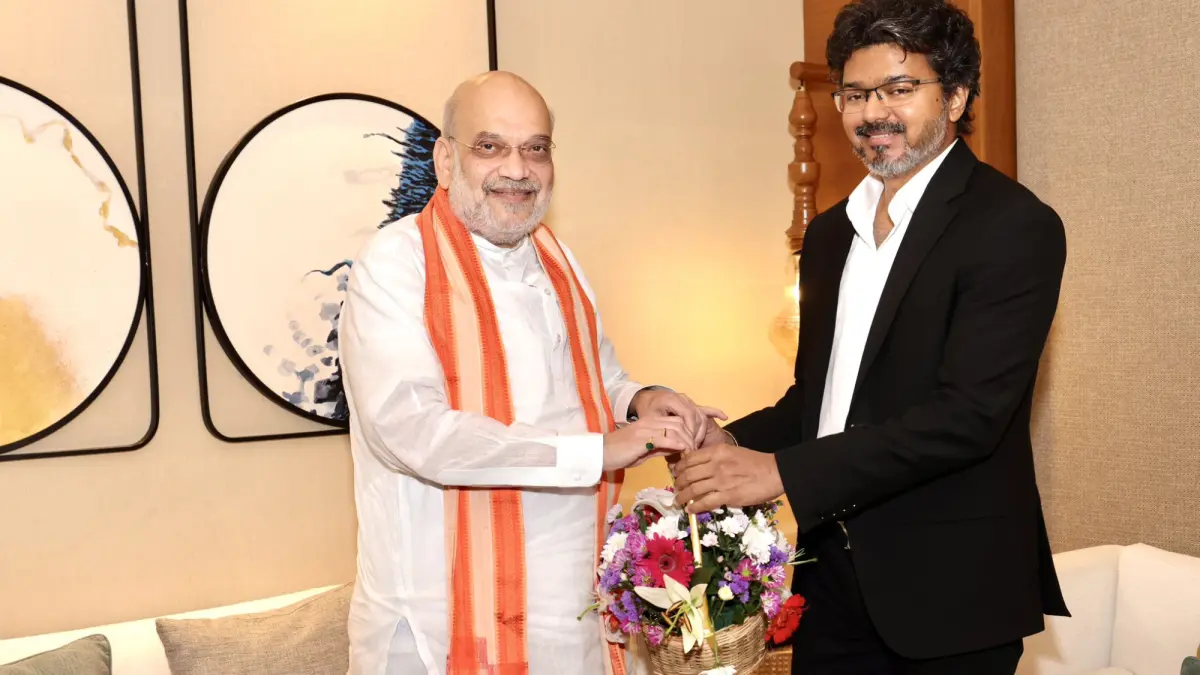
Union Home Minister Amit Shah met Tamil Nadu Chief Minister C. Joseph Vijay in Chennai, a day before Shah was scheduled to chair the 31st Southern Zonal Council Meeting at Kovalam near Mamallapuram in Chengalpattu district on Thursday, August 20.
The meeting came at a time when several important inter-state issues, particularly water-sharing disputes and the proposed Godavari-Cauvery river-linking project, are expected to dominate discussions among southern states.
It was also the first reported meeting between the two leaders since Vijay took office as Tamil Nadu Chief Minister.
With the Southern Zonal Council bringing together the Centre and governments from across southern India, the interaction allowed the Tamil Nadu Chief Minister to discuss issues that could become important during the formal deliberations.
What Is The Southern Zonal Meeting?
The Southern Zonal Council is a statutory forum created under the States Reorganisation Act, 1956.
Its purpose is to encourage cooperation among states and Union Territories in the region and provide a structured platform for discussing issues that affect more than one government.
The council covers Andhra Pradesh, Karnataka, Kerala, Tamil Nadu and Telangana, along with the Union Territories of Puducherry, Andaman and Nicobar Islands, and Lakshadweep.
The meetings are intended to help governments resolve disputes through discussion rather than allowing issues to remain unresolved between individual states.
The Union government has described the councils as forums for resolving issues and disputes between the Centre and member states and Union Territories.
It is being held at Kovalam near Mamallapuram in Chengalpattu district, Tamil Nadu, with reports identifying a seaside hotel on East Coast Road as the venue. Amit Shah is chairing the meeting.
The session is scheduled to begin at around 10 a.m. and is expected to run for several hours.
The meeting has drawn additional attention because the Southern Zonal Council conference has not been held since 2022, according to reports.
That makes the return of the high-level forum particularly significant for discussions involving the southern states.
Who Are Expected To Attend?
Tamil Nadu Chief Minister Vijay is participating as the host state's Chief Minister.
The other southern states and the Union Territory of Puducherry are expected to be represented by their Chief Ministers or senior representatives.
N. Chandrababu Naidu, Chief Minister of Andhra Pradesh
D. K. Shivakumar, Chief Minister of Karnataka
V. D. Satheesan, Chief Minister of Kerala
A. Revanth Reddy, Chief Minister of Telangana, with reports indicating that Deputy Chief Minister Mallu Bhatti Vikramarka is likely to represent Telangana in his absence
N. Rangasamy, Chief Minister of Puducherry
Chief secretaries, home secretaries and other senior officials from the participating governments are also expected to take part in the deliberations.
The council's wider membership also includes the Union Territories of Andaman and Nicobar Islands and Lakshadweep.
Key Issues For Discussion
The agenda for the 31st Southern Zonal Council Meeting involves a highly structured mix of critical inter-state disputes, administrative policies, and urgent regional concerns.
Water Sharing and River Disputes
The Godavari-Cauvery river-linking proposal is expected to be one of the key issues discussed at the meeting.
Vijay is likely to urge the Centre to speed up the project and seek national project status, as Tamil Nadu considers it important for addressing water shortages and improving water availability in the Cauvery basin.
The proposed route would link the Godavari, Krishna, Pennar, Palar and Cauvery rivers, requiring coordination among the states involved.
The long-running Cauvery water dispute between Tamil Nadu and Karnataka is another major issue.
Vijay is expected to raise Tamil Nadu's concerns, while Karnataka Chief Minister D. K. Shivakumar may present Karnataka's position, including its plans concerning the Mekedatu project.
The Mullaperiyar water issue between Tamil Nadu and Kerala is also expected to be discussed. These water-related disputes are particularly sensitive because they directly affect agriculture, drinking-water supply and the livelihoods of millions of people.
Law, Order And Social Infrastructure
Rolling out and funding specialised courts to ensure the speedy trial of cases involving rape and crimes against women and children.
Improving real-time coordination among state law enforcement agencies to tackle cross-border crimes and resolve territorial border disputes.
Economic Growth And Federal Relations
Demands for equitable financial allocation and infrastructure funds from the Union Government.
Resolving pending bifurcation matters, including the funding of the Polavaram and Amaravati development projects.
The Southern Zonal Council can help governments arrive at decisions or recommendations. Still, many of the issues on the table require further action from individual state governments, Union ministries or specialised agencies.