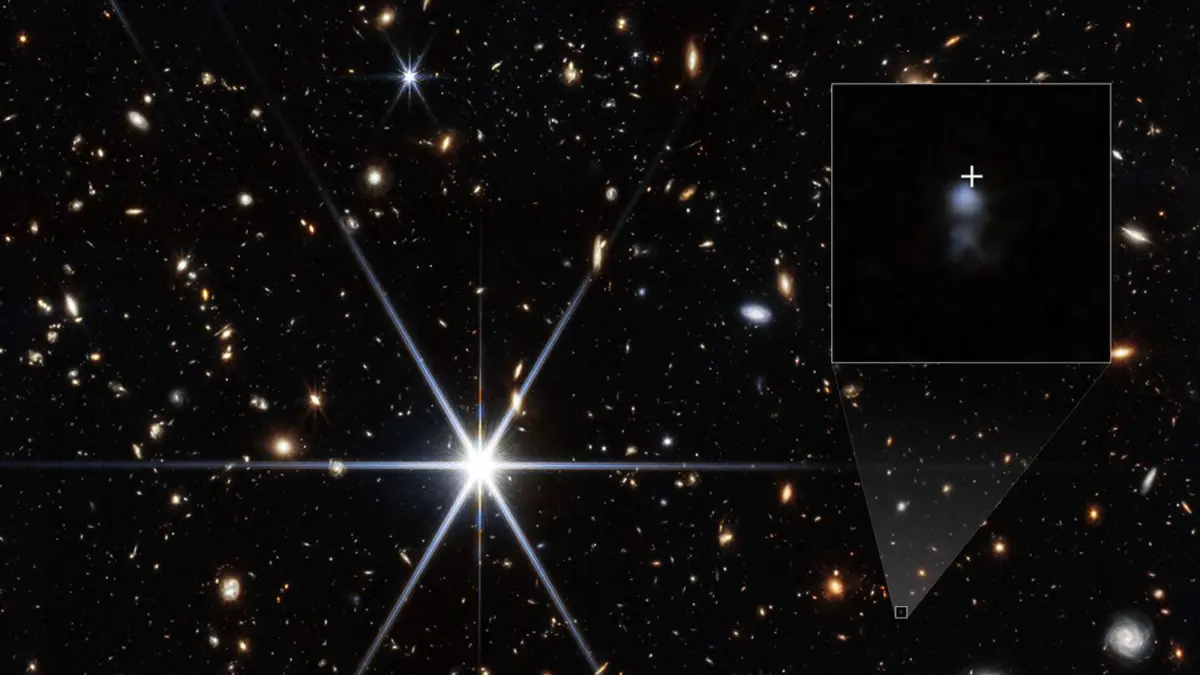
Astronomers have detected the most distant fast radio burst (FRB) ever recorded, identifying a powerful radio signal that travelled approximately 11 billion light-years before reaching Earth.
Named FRB 20240304B, the signal offers scientists a rare opportunity to study the early universe and the matter spread between galaxies.
The discovery more than doubles the distance of the previous record holder, marking a significant step forward in studying these mysterious cosmic signals.
The radio burst lasted only a few milliseconds and originated when the universe was approximately three billion years old.
Because the universe is estimated to be about 13.8 billion years old, the signal began its journey long before Earth and the solar system formed.
How Was the Distant Radio Burst Detected?
The discovery was made by the MeerTRAP project, which uses South Africa's MeerKAT radio telescope to search for fast radio bursts.
Following the detection, astronomers used observations from NASA's James Webb Space Telescope to identify the galaxy associated with the signal.
Fast radio bursts are intense flashes of radio waves that typically last only a few milliseconds. Despite their brief duration, they can release enormous amounts of energy, making them important objects of study for astronomers.
However, their short lifespan makes them difficult to study. Many FRBs are detected only once, leaving researchers with limited opportunities to determine their precise origins.
Scientists first discovered fast radio bursts in 2007, but their exact origins remain uncertain.
A Young, Unexpectedly Small Galaxy
Observations revealed that FRB 20240304B originated in a small dwarf galaxy that was actively forming stars. The galaxy was approximately 1,000 times less massive than researchers had expected.
The findings also indicated that the galaxy was remarkably young, with around 90% of its stellar mass having formed within the preceding 30 million years.
This discovery suggests that fast radio bursts can emerge from environments that differ from those commonly associated with previously studied signals.
Researchers suspect that the burst may have been produced by a magnetar, an extremely magnetised neutron star left behind after a massive star reaches the end of its life.
Magnetars can release enormous amounts of magnetic energy, making them possible sources of powerful radio bursts.
However, scientists have not yet confirmed the exact object responsible for FRB 20240304B.
Radio Signals Reveal Hidden Matter Between Galaxies
Beyond identifying the distant galaxy, the discovery could help astronomers investigate matter that is otherwise difficult to observe.
As radio waves travel across the universe, they pass through gas and other material located between galaxies. Ionised gas can alter the signals, leaving measurable effects that researchers can analyse to understand the material encountered during their journey.
Because FRB 20240304B travelled for billions of years before reaching Earth, its signal provides valuable information about the matter distributed along its path.
Manisha Caleb, co-leader of the research team at the Sydney Institute for Astronomy, said the detection offered a glimpse into the universe when it was only about three billion years old.
The burst also provided information about the material through which its radio waves had travelled over billions of years.
Why Is This Discovery Important?
Detecting such a distant fast radio burst expands the possibilities for studying the early universe. These signals can act as cosmic probes, allowing astronomers to investigate distant galaxies and measure material that might otherwise remain difficult to detect.
The unexpectedly low mass and young age of the galaxy associated with FRB 20240304B also raise new questions about the environments in which these bursts occur.
Although the signal source remains unconfirmed, the discovery shows how radio telescopes and space observatories can work together to trace brief cosmic events across enormous distances.
Further observations could help scientists determine whether a magnetar produced the burst and establish how fast radio bursts are generated in young galaxies.