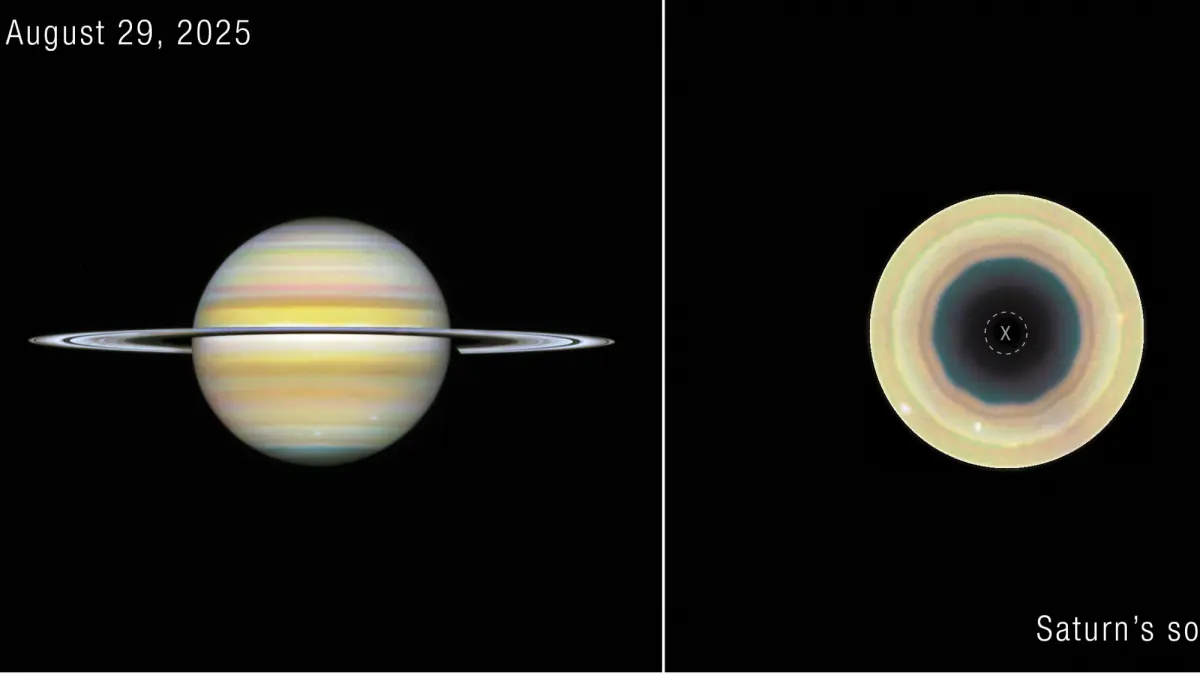
NASA's Hubble Space Telescope has spotted a remarkable atmospheric structure developing around Saturn's south pole - a giant, evolving wave with 10 distinct sides.
The discovery marks the first time astronomers have observed such a large, regularly shaped jet-stream pattern in Saturn's southern hemisphere.
The newly detected feature bears a striking resemblance to Saturn's famous six-sided hexagon at its north pole, but its 10-sided shape and apparent evolution suggest that scientists may be witnessing a previously unknown atmospheric phenomenon.
How the Discovery Was Made
Researchers identified the structure by combining several years of Hubble observations, including images dating back to 2023. The feature initially appeared only as subtle disturbances before gradually becoming more clearly defined.
NASA's Outer Planet Atmospheres Legacy (OPAL) programme collected the observations, monitoring the solar system's outer planets for more than a decade. Hubble's long-term observations let scientists track atmospheric changes instead of relying on individual snapshots.
The discovery became possible as Saturn's changing seasons gradually brought its southern pole back into view from Earth.
Astronomers analysing observations from ground-based telescopes first noticed indications of the unusual pattern, which were later supported by Hubble's high-resolution observations.
Hubble's position above Earth's atmosphere gives it a major advantage when studying Saturn. Unlike ground-based telescopes, it can capture sharp images of the planet throughout its full rotation without atmospheric distortion or smearing.
A Long-Searched Southern Counterpart
Researchers have been searching for a southern counterpart to Saturn's northern hexagon for decades.
According to planetary scientist Agustín Sánchez-Lavega, scientists have looked for such a feature in Hubble observations since 1990. However, images from NASA's Cassini spacecraft, which studied Saturn from 2004 to 2017, showed no evidence of a long-lived formation like this.
What the Data Reveals
The latest Hubble data indicate that the 10-sided wave was already present by 2023. The structure lies within one of Saturn's powerful jet streams and appears to extend through several atmospheric layers. This suggests that it is more than a feature confined to the planet's visible cloud tops.
Its position also appears to shift slightly depending on the observation wavelength. Scientists believe this is because different wavelengths allow Hubble to examine different atmospheric altitudes.
What Comes Next
The findings highlight the importance of long-term planetary observations. Through OPAL, Hubble has monitored seasonal changes on the outer planets, tracked short-lived storms, and identified atmospheric structures that develop gradually over several years.
Scientists will continue monitoring Saturn to determine whether the newly discovered decagon eventually settles into a stable, long-lasting pattern like the northern hexagon or keeps changing.
Future observations could provide clues about what drives the unusual wave and help researchers better understand Saturn's atmospheric dynamics, those of other giant planets, and the broader physical processes that shape planetary atmospheres.