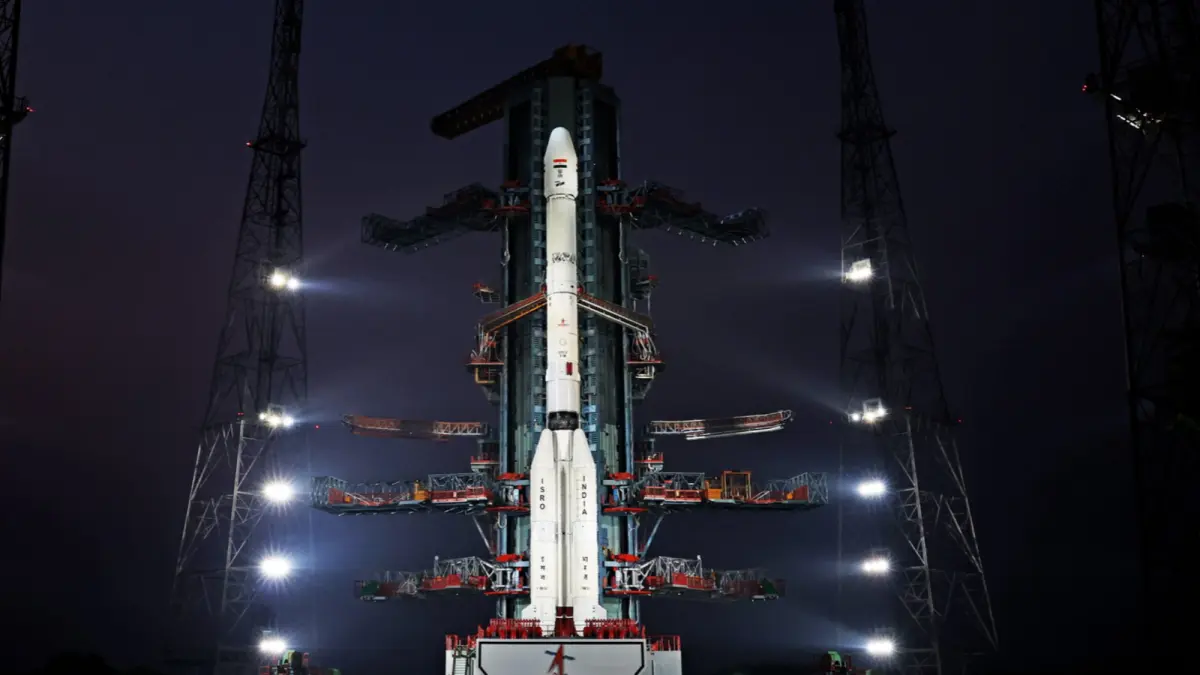
ISRO successfully launched the NVS-03 satellite on Friday from the Satish Dhawan Space Centre in Sriharikota, India. PM Modi sent regards to ISRO.
Launch details of the satellite
ISRO successfully launched the NVS-03, its next-generation navigation satellite, on October 30, 2026, at 11:51 PM IST from the Second Launch Pad at the Satish Dhawan Space Centre in Sriharikota, India.
Heavy rainfall from a deep depression over the Bay of Bengal initially delayed the liftoff from its original 9:00 PM schedule. Still, the 42.1-metre-tall GSLV-F18 rocket successfully pierced through the cloud cover to mark the 20th flight of the Geosynchronous Satellite Launch Vehicle.
Approximately 18 minutes after launch, the vehicle precisely deployed the 2,250 kg next-generation satellite into a Geosynchronous Transfer Orbit (GTO).
The satellite is the third in ISRO's next-generation navigation satellite series to modernise India's independent navigation system (NavIC) and ensure long-term operational reliability under the Indian Regional Navigation Satellite System (IRNSS).
PM Modi wishes to ISRO
In an X post, Narendra Modi highlighted the satellite's enhanced capabilities and said it would support a navigation service that benefits people.
He commented, "Congratulations to our scientists and engineers at ISRO on the successful launch of GSLV-F18 carrying NVS-03. This mission marks an important step in strengthening NavIC, our indigenous satellite navigation system".
Modi also said the satellite is equipped with enhanced capabilities and that NVS-03 will further our pursuit of self-reliance in critical technologies and support navigation services that benefit our people. The dedication and ingenuity of our space scientists continue to make our nation proud.
Satellite details
The NVS-03 satellite carries a dedicated L1 frequency band (1575.42 MHz). This is the standard signal used by global commercial GPS systems, allowing everyday smartphones and wearable civil navigation devices to access NavIC data without needing specialised hardware.
The system is designed to provide coverage over India's landmass and an area extending 1,500 kilometres beyond its geopolitical boundary.
NVS-03 directly reinforces the ageing regional navigation network. It replaces older, degrading first-generation IRNSS satellites, ensuring uninterrupted coverage for defence, disaster management, and commercial fleet tracking.
The payload maintains positioning accuracy better than 20 metres for standard civilian users and under 10 metres for restricted military applications, covering the entire Indian mainland and extending roughly 1,500 km beyond its geographic borders.
After the satellite launch, ISRO Chairman V. Narayanan said three navigation satellites, including NVS-01, were already operational. With the addition of NVS-03, the constellation has restored position, navigation and Timing services.
He also highlighted the NavIC constellation's role in the government's one nation, one time project. He said the mission will strengthen India's Standard Time infrastructure, particularly after the government notified the Legal Metrology Rules.
He noted that the mission was completed in just 56 days between two successive GSLV launches.