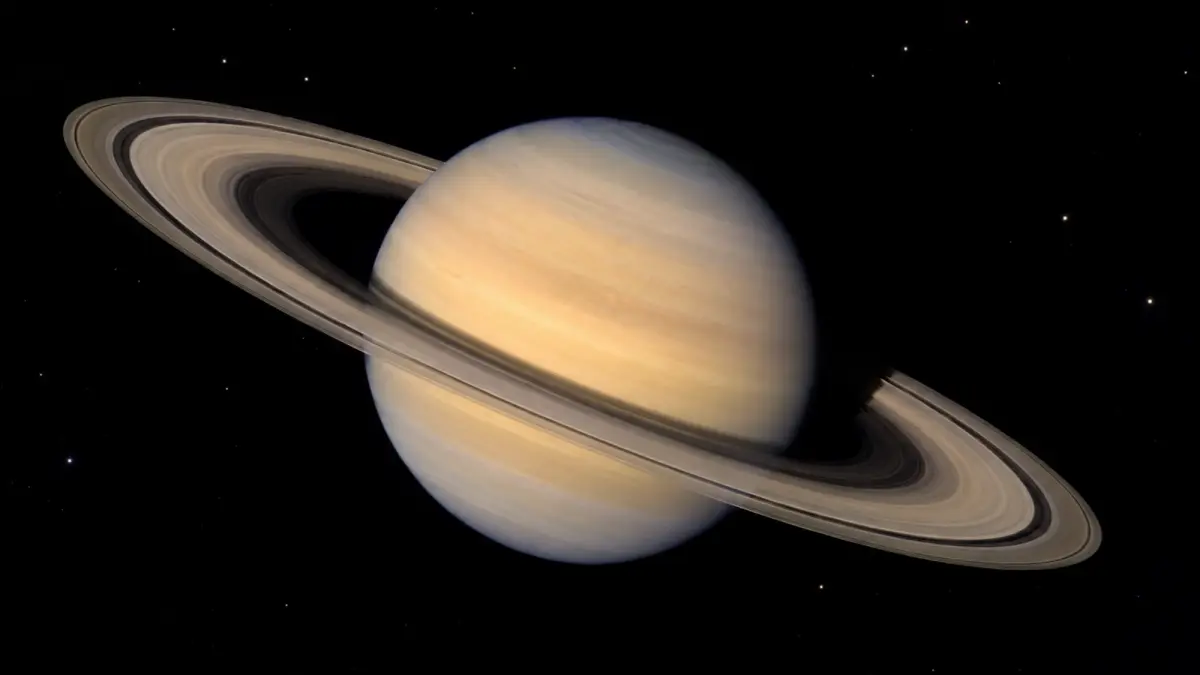
Skywatchers had a special opportunity to observe Saturn on October 4, when the ringed planet reached opposition. The event occurs when Earth moves between the Sun and Saturn, placing Saturn almost directly opposite the Sun in Earth's sky.
As a result, the planet rises around sunset, remains visible throughout most of the night and sets around sunrise. NASA included Saturn's opposition among its major skywatching highlights for October 2026.
Opposition is particularly useful for telescope observers because Saturn is visible for much of the night and reaches its largest apparent size for the year around this period.
In 2026, Saturn was also relatively bright, reaching about magnitude 0.3 and appearing as a steady point of light to the unaided eye.
Why Saturn's rings can appear brighter
The October opposition also highlights a phenomenon known as the Seeliger effect, or opposition surge. It refers to a temporary increase in the apparent brightness of Saturn's rings when the viewing geometry is close to opposition.
Saturn's rings are made primarily of water-ice particles. Under ordinary viewing conditions, these particles can cast shadows on one another.
Near opposition, the Sun is almost directly behind the observer from Saturn's perspective, causing many of those shadows to disappear from view. More illuminated particles are therefore visible, making the rings appear brighter.
Scientists also associate the opposition surge with light-scattering effects such as coherent backscattering. NASA has documented this brightening effect in observations of Saturn's rings.
Saturn's rings are opening again
The 2026 opposition is also interesting because Saturn's rings are gradually becoming more visible after reaching an almost edge-on orientation as viewed from Earth in 2025.
Earth crossed Saturn's ring plane in March 2025, an event that occurs roughly every 13 to 15 years. By October 2026, the rings had begun opening again, although their tilt toward Earth remained relatively small compared with years when the rings are more widely angled.
This allows telescope users to watch the changing orientation of the famous ring system over the coming years.
When and where to look for Saturn
Saturn is not particularly dramatic to the naked eye. It appears as a bright, steady creamy-white or golden point of light and generally does not twinkle like nearby stars.
The planet rises in the east around sunset and remains above the horizon for most of the night. Around midnight, Saturn climbs higher in the sky, making this one of the best times to observe it because it is farther from the haze and turbulence near the horizon.
Saturn was positioned in front of the constellation Cetus, the Whale, during its 2026 opposition.
For observers in the Southern Hemisphere, Saturn can reach a relatively favourable position in the sky. With a telescope, its rings become the main attraction, while several of its moons may also be visible under suitable observing conditions.
While you can spot Saturn without optical equipment, a telescope provides a far more impressive view, revealing the planet's disc and ring system.