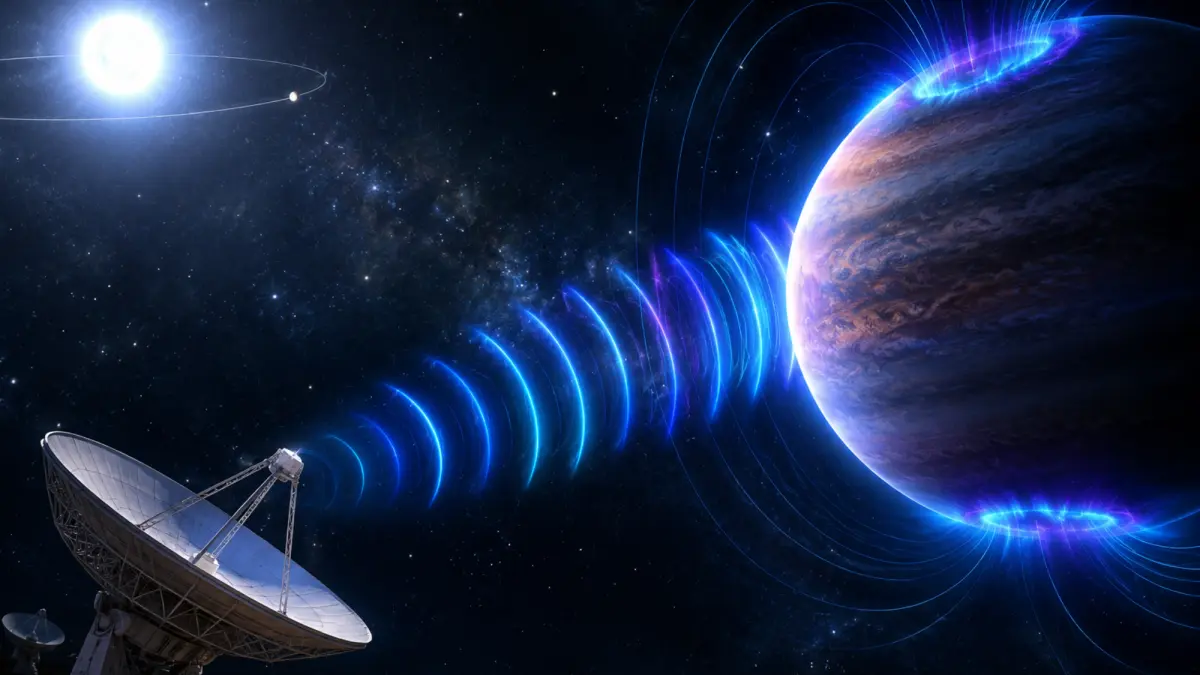
Scientists have detected unusual radio signals coming from Beta Pictoris b, a giant exoplanet located about 63 light-years from Earth. The observation could provide the clearest evidence yet of auroral radio emission originating directly from an exoplanet rather than its host star.
Researchers from the Centre for Astrophysics, Harvard & Smithsonian and the University of Oregon made the discovery using South Africa's MeerKAT radio telescope array to study the Beta Pictoris system.
Radio Bursts Traced To The Planet
The researchers observed the system four times in 2025 and 2026. During these observations, MeerKAT detected short, repeating bursts of radio waves along with persistent radio emission.
The signals were detected across frequencies between 0.85GHz and 3.5GHz and showed strong circular polarisation.
Using distant quasars as reference points for their radio maps, the researchers determined that the emission was associated with Beta Pictoris b, rather than the much brighter Beta Pictoris star.
The team identified the radiation as electron cyclotron maser emission, a process associated with strong magnetic fields and auroral activity.
What Causes The Radio Signals?
Auroras occur when charged particles interact with a planet's magnetic field and atmosphere. On Earth, this interaction produces the northern and southern lights, but similar processes can also generate radio waves.
The researchers believe the radio bursts from Beta Pictoris b result from a related auroral process. The emission's characteristics provide evidence that the planet has a powerful magnetic field.
Based on the detected radio frequencies, the researchers estimate a magnetic field strength of around 1.25 kilogauss at the source. If confirmed, this would represent a direct measurement of an exoplanet's magnetic field using auroral radio emission.
Why Beta Pictoris b Is Important
Beta Pictoris b is a massive gas giant with a mass of approximately 11.7 times that of Jupiter. It orbits the A-type star Beta Pictoris at about 10 astronomical units and takes roughly 23.6 years to complete one orbit.
Astronomers discovered the planet in 2008 and have studied it extensively because of its relatively young planetary system and large size.
Radio observations could offer astronomers a new way to study magnetic fields around distant planets. Such fields are important because they influence how planets interact with radiation and charged particles from their host stars.
Auroral radio emission has previously been observed from planets in our Solar System and from some ultracool dwarfs. However, the researchers say previous observations had not unambiguously localised this type of emission to an exoplanet rather than its host star.
Not An Alien Broadcast
Although the discovery involves radio signals from a distant planet, there is no evidence that an extraterrestrial civilisation produced them.
The observed characteristics match a natural physical process involving the planet's magnetic field and charged particles.
The finding is therefore significant for what it reveals about the planet's magnetic environment, rather than for any indication of intelligent life.
The research is available as an arXiv preprint and has not yet been published in a peer-reviewed journal. Further observations and independent analysis will be important to confirm the result and learn more about Beta Pictoris b's magnetic field and auroral activity.