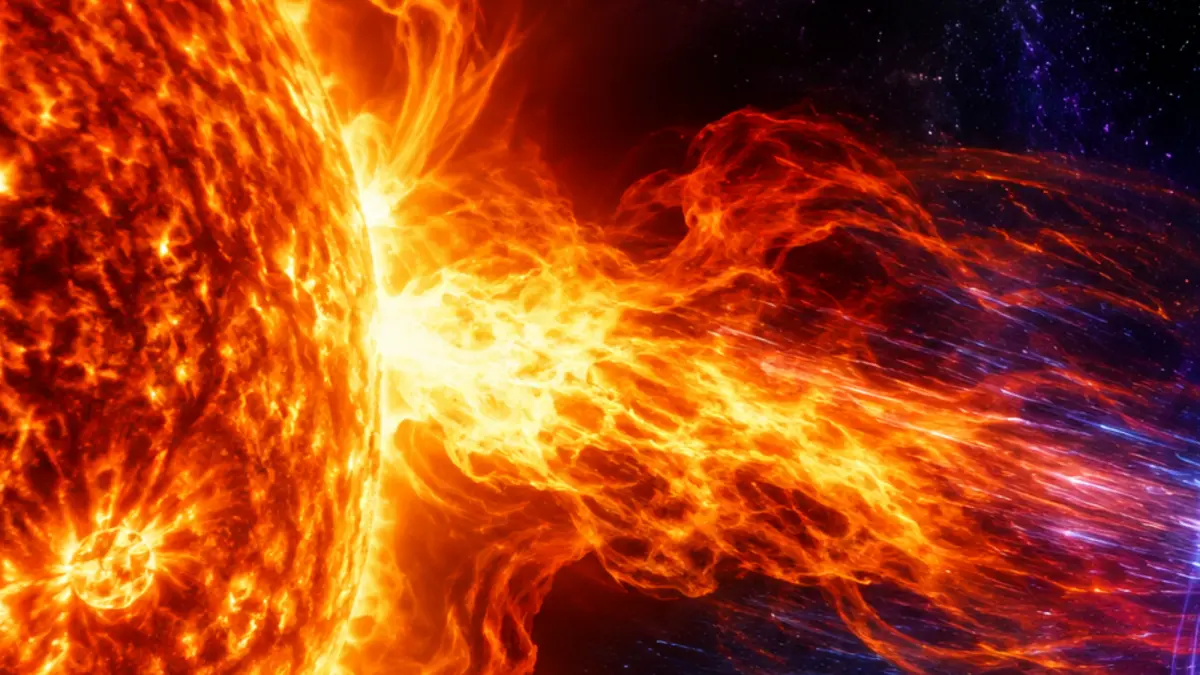
Earth is bracing for a possible geomagnetic storm after the Sun unleashed two eruptions that sent clouds of charged particles towards our planet.
The US National Oceanic and Atmospheric Administration (NOAA) has issued a watch for a moderate G2 geomagnetic storm, warning of potential effects on satellites, radio communications, navigation systems and Earth's magnetic field.
The solar activity could also produce spectacular auroras, potentially making them visible farther from the polar regions than usual.
However, the actual impact will depend on the speed, strength and magnetic properties of the solar material when it reaches Earth.
Why Has NOAA Issued a Solar Storm Watch?
According to NOAA's Space Weather Prediction Center, the G2 watch covers two solar eruptions that occurred on October 7 and October 8. The second eruption is travelling faster than the first and is expected to catch up with it before the combined material reaches Earth.
These eruptions can release enormous quantities of electrically charged particles and magnetic material into space. When this material interacts with Earth's magnetic field, it can trigger a geomagnetic storm.
Scientists are monitoring the incoming solar material to determine how strongly it will interact with Earth's magnetic field. Although the forecast points to a moderate disturbance, the final intensity may change as more information becomes available.
What Is a Solar Storm?
A solar storm is a space weather event caused by activity on the Sun. One major trigger is a coronal mass ejection (CME), a large release of plasma and magnetic fields from the Sun's outer atmosphere.
When a CME travels towards Earth, its charged particles and magnetic field can interact with Earth's protective magnetic field. This interaction can disturb the planet's magnetic environment and produce a geomagnetic storm.
The strength of these storms depends on several factors, including the speed of the incoming material, its density and the orientation of its magnetic field.
How Strong Is the Expected Geomagnetic Storm?
NOAA classifies geomagnetic storms on a five-level scale, ranging from G1, a minor storm, to G5, an extreme event.
A G2 storm is classified as moderate. Although it is not considered an extreme space weather event, it can cause certain technological disruptions, particularly at higher latitudes.
NOAA also uses separate scales to measure other space weather events. Solar radiation storms are rated from S1 to S5, while radio blackouts are rated from R1 to R5.
These classifications describe different phenomena and should not be confused with the G-scale used for geomagnetic storms.
What Will Happen When the Solar Storm Reaches Earth?
If the incoming solar material triggers a G2 geomagnetic storm, several effects are possible.
1. Auroras Could Become Visible in More Regions
One of the most noticeable effects could be auroras appearing farther from the polar regions than usual.
These colourful displays occur when charged particles interact with gases in Earth's upper atmosphere. The resulting emissions produce glowing patterns across the night sky.
However, aurora visibility depends on the storm's intensity, local darkness, weather conditions, and geographical location.
2. Satellites Could Experience Disruptions
Geomagnetic storms can affect satellite operations by increasing atmospheric drag on satellites in low Earth orbit. Satellite operators may need to adjust their operations or orbital calculations.
Changes in the space environment can also affect satellite electronics and communication systems, although the level of impact depends on the storm's characteristics.
3. GPS and Navigation Accuracy Could Be Affected
Geomagnetic disturbances can alter the ionosphere, a region of Earth's upper atmosphere through which satellite navigation signals travel.
These changes can introduce errors into GPS and other satellite-based navigation systems. During a moderate storm, the effects may vary by location and may be more noticeable for systems that require high positioning accuracy.
4. Radio Communications May Weaken
Some radio communication systems could experience signal degradation during the storm.
The impact will depend on the frequency used, the receiver's location, and the state of Earth's upper atmosphere. Certain high-frequency radio communications may be more vulnerable to space weather disturbances.
5. Power Grids Could Experience Minor Disturbances
Geomagnetic storms can induce electrical currents in long conductors, including power transmission lines.
At G2 levels, power systems at higher latitudes could experience voltage fluctuations, and grid operators may need to monitor conditions. However, a moderate storm does not automatically mean widespread power outages.
Will the Solar Storm Affect India?
For India, the expected G2 geomagnetic storm does not currently indicate a major direct threat to everyday life.
The country is located at relatively low geographic latitudes, meaning that the most noticeable geomagnetic effects are generally expected closer to the polar regions.
Widespread power cuts, major communication failures or significant disruptions to daily activities are not expected solely because of this forecast.
Auroras are also unlikely to become visible across most of India during a moderate G2 storm. Although stronger geomagnetic storms can sometimes push auroral displays towards lower latitudes, there is no reason to assume that this event will produce such a spectacle over the country.
Satellite navigation, telecommunications and other infrastructure are designed to operate under a range of environmental conditions.
Nevertheless, operators continue to monitor space weather because the effects can vary depending on the actual conditions.
Should People Be Worried About the Solar Storm?
The general public does not need to panic over the current G2 watch. A moderate geomagnetic storm is not expected to pose a direct physical danger to people on Earth's surface.
Earth's atmosphere and magnetic field provide substantial protection from many of the effects of solar activity. The principal concerns during geomagnetic storms involve certain technological systems rather than immediate threats to human health.
Scientists will continue to monitor the incoming solar material as it approaches Earth. Measurements of its speed, density and magnetic orientation will help determine whether the storm reaches the predicted G2 level or produces a weaker or stronger disturbance.
For now, the forecast remains a warning of possible space weather activity, not confirmation that significant disruptions will occur. The final impact will become clearer as the solar material interacts with Earth's magnetic field.