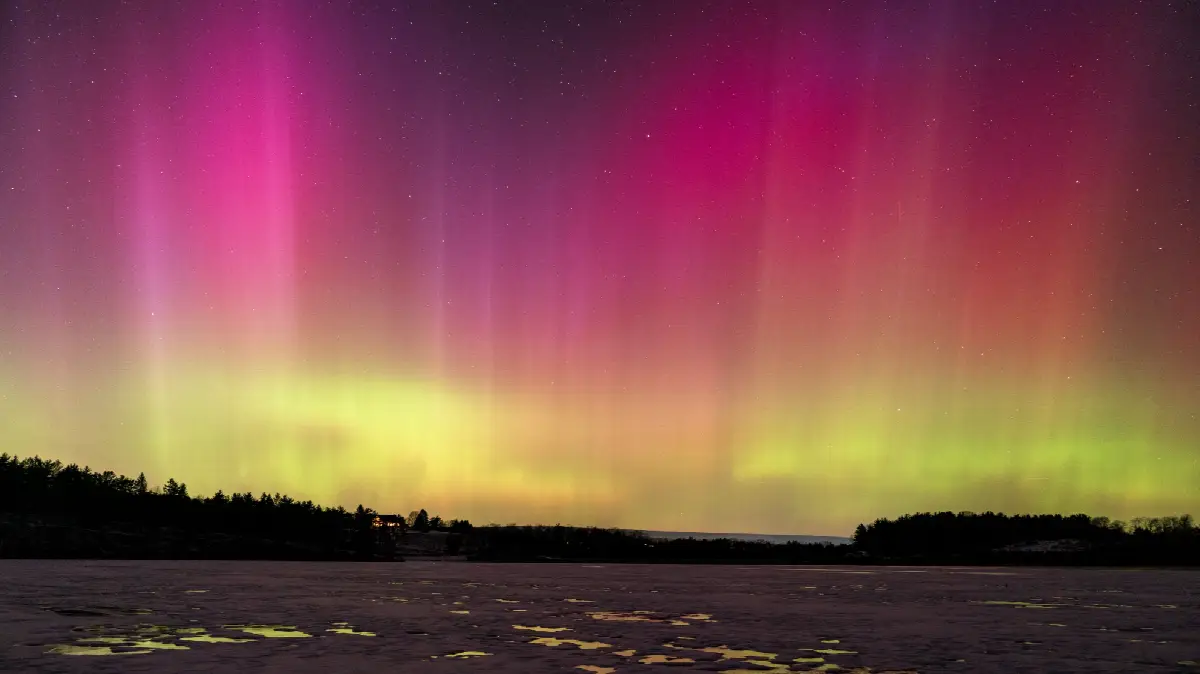
Earth experienced a rare and powerful geomagnetic storm on January 19, 2026, after a surge of intense solar activity struck the planet's magnetic field. The event, described by scientists as the strongest solar storm in more than 20 years, illuminated skies with vivid auroras across large parts of the United States and Europe.
The storm was triggered by an X1.9-class solar flare that erupted from a dark region near the Sun's equator on January 18. The flare peaked at 2:38 pm EST, releasing a fast-moving coronal mass ejection (CME), a massive cloud of charged solar particles that travelled rapidly toward Earth.
When the CME collided with Earth's magnetosphere on January 19, it temporarily disrupted the planet's magnetic field, allowing energetic particles to penetrate deeper into the atmosphere. This interaction produced widespread auroral displays at unusually low latitudes, a rare phenomenon for many regions.
The National Oceanic and Atmospheric Administration (NOAA), through its Space Weather Prediction Centre (SWPC), confirmed that the storm reached a G4 "severe" level, the second-highest category on the geomagnetic storm scale. A follow-up report noted that the storm again intensified to G4 status at 3:23 am EST on January 20.
As a result, brilliant northern lights were seen across the UK and several European countries, including France, Germany, Switzerland, Austria, Belgium, Norway, Denmark, the Netherlands, and Croatia. In the US, auroras were visible or expected in up to 24 states, extending far beyond their usual range.
Space weather experts said the storm broke a solar radiation record that had stood for more than two decades, making it the most significant event since the Halloween solar storms of October 2003. Those earlier storms caused widespread power outages in Sweden and damaged electrical infrastructure in South Africa.
While no major disruptions have been reported so far, G4-level storms can cause temporary radio blackouts, satellite interference, and navigation issues. They may pose a radiation risk to astronauts aboard the International Space Station and to passengers on flights over polar regions.
Scientists are continuing to closely monitor solar activity, warning that as the Sun approaches the peak of its current cycle, more intense space weather events could follow, offering both breathtaking auroras and potential technological challenges.