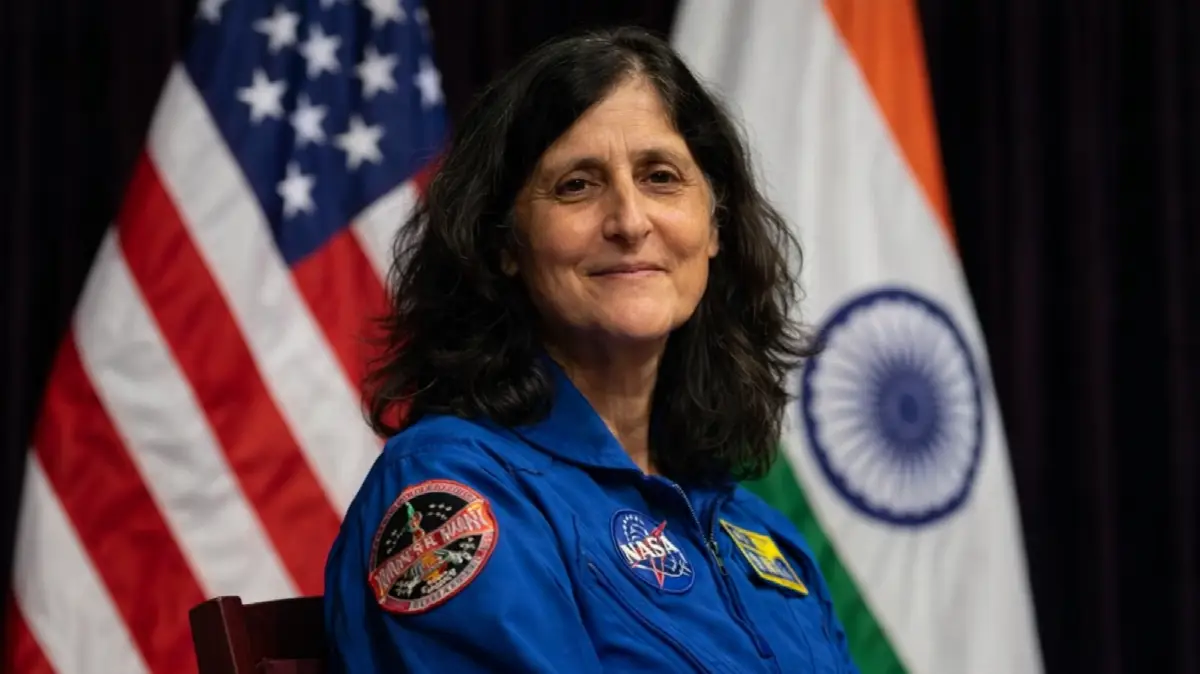
Sunita Williams has officially retired from NASA, concluding a 27-year career that redefined human spaceflight and inspired millions worldwide. One of the most respected figures in space exploration, Williams steps away after setting records and leading critical missions aboard the International Space Station (ISS).
Over the course of her career, Williams spent a total of 608 days in space, including an unplanned nine-month mission on the ISS, placing her among the most experienced astronauts in history. NASA Administrator Jared Isaacman praised her as a visionary leader whose work helped steer the future of human exploration beyond Earth.
Williams played a crucial role during a transformative era for NASA, contributing to the rise of commercial space missions and strengthening operations in low Earth orbit. She logged 286 days in space during NASA's Boeing Starliner and SpaceX Crew-9 missions, a milestone she shares with astronaut Butch Wilmore.
Renowned for her expertise in extravehicular activity, Williams completed 9 spacewalks, spending 62 hours and 6 minutes working outside the spacecraft. Her efforts were vital in maintaining the ISS and expanding its scientific and operational capabilities.
In a tribute shared on X, Isaacman said Williams' contributions have left a lasting impact, noting that her work advancing science and space technology helped lay the foundation for NASA's Artemis programme, which aims to return humans to the Moon and eventually journey to Mars.
Williams' space career began in December 2006, when she launched aboard Space Shuttle Discovery on the STS-116 mission. She later returned on STS-117 aboard Space Shuttle Atlantis and served as a flight engineer during Expeditions 14 and 15, completing a then-record four spacewalks.
Her second long-duration mission came in 2012, when she launched from Kazakhstan's Baikonur Cosmodrome for a 127-day stay on the ISS as part of Expeditions 32 and 33. During that mission, she commanded Expedition 33 and conducted three spacewalks to repair a radiator leak and replace a key power system component.
In her later years, Williams returned to the ISS for Expeditions 71 and 72, taking command of the station during Expedition 72. She completed two more spacewalks before returning to Earth in March 2025 aboard NASA's SpaceX Crew-9 mission.
Beyond orbit, Williams held several leadership roles on the ground. She participated in NASA's NEEMO programme in 2002, living underwater for nine days to simulate space conditions. After her first spaceflight, she became deputy chief of NASA's Astronaut Office, later serving as director of operations in Russia. In her final role, she helped develop a helicopter-based training system to prepare astronauts for future Moon missions under the Artemis initiative.
Her achievements also resonated deeply in India. While she was aboard the ISS, Prime Minister Narendra Modi, in a letter delivered by astronaut Mike Massimino, referred to her as "India's daughter", saying she remained close to the hearts of 1.4 billion Indians despite being far from Earth.
As Sunita Williams retires, she leaves behind a powerful legacy of leadership, endurance, and discovery, one that will continue to inspire future generations of explorers.