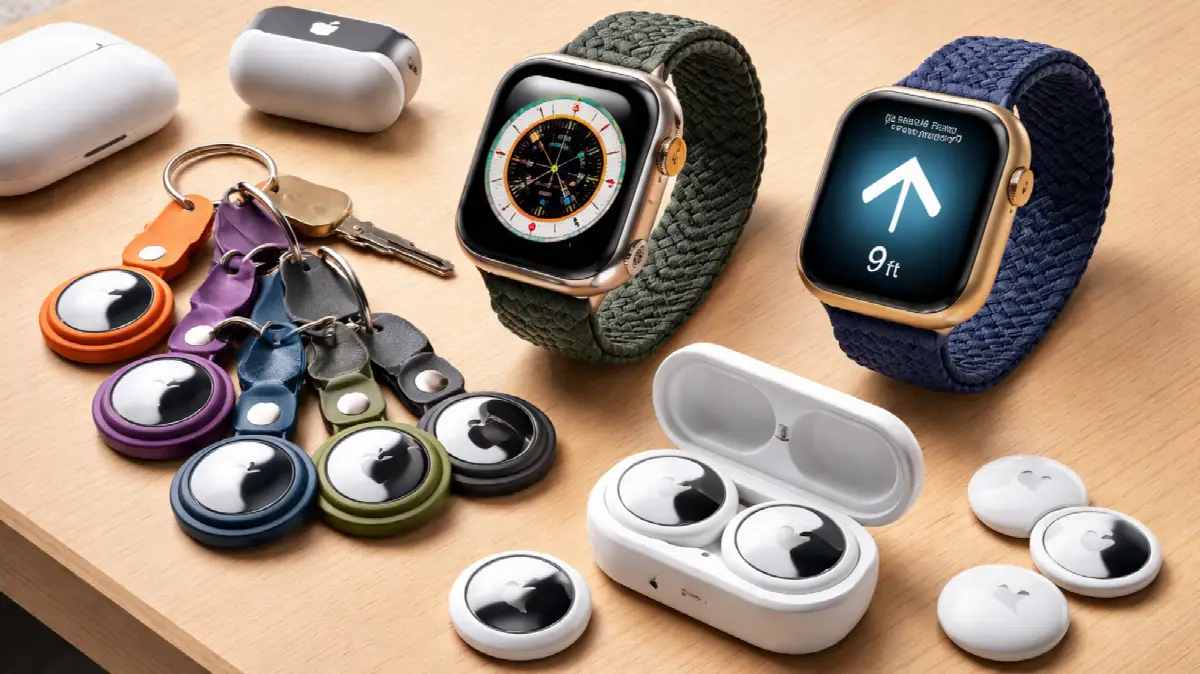
Apple's launch of AirTag 2 may appear like a routine hardware refresh. Still, it quietly signals something deeper, a calculated move to strengthen its ecosystem moat at a time when flashy AI features dominate headlines. Rather than chasing attention, Apple is doubling down on trust, reliability, and long-term ecosystem stickiness.
The second-generation AirTag is powered by Apple's latest Ultra Wideband (UWB) chip, the same technology used in newer iPhones and Apple Watches. This upgrade extends Precision Finding by up to 50 per cent, allowing users to locate lost items from much farther away. Apple has also improved Bluetooth performance, widening the overall tracking range.
Internally, the AirTag has been redesigned with a speaker that is 50 per cent louder, making it audible from nearly twice the distance compared to the previous generation. These changes focus squarely on real-world usefulness rather than feature hype.
A key shift is deeper Apple Watch integration. Precision Finding now works directly on Apple Watch Series 9 and later, and Watch Ultra 2 and above, transforming AirTag from a phone-first accessory into a wrist-based navigation tool. This subtle move turns the watch into a practical, everyday locator, not just a convenience upgrade, but a meaningful expansion of how Apple devices interact in daily life.
AirTag is available for purchase in single and four-pack options, priced at $29 (U.S.) and $99 (U.S.), respectively. Apple has also introduced the AirTag FineWoven Key Ring, offered in fox orange, midnight purple, navy, moss, and black, with a retail price of $35 (U.S.).
The new AirTag is compatible with iPhone models running iOS 26 or later, as well as iPads on iPadOS 26 or later. Users must be signed in with an Apple Account and iCloud, and certain features require Find My to be enabled in iCloud settings.
For Precision Finding on Apple Watch, users need an Apple Watch Series 9 or later, or an Apple Watch Ultra 2 or later, running watchOS 26.2.1 or later.
AirTag behaves like infrastructure that needs scale, while the Unity band functions as identity, reinforcing Apple's premium, aspirational narrative.
Together, these launches strengthen Apple's grip on the physical world through Find My, while also enhancing cultural visibility through wearables.
In markets like urban India, Apple Watch bands act as subtle social signals, making the ecosystem feel personal and communal rather than purely technical.
As Apple keeps its core device cycles steady, these quieter ecosystem upgrades may be the company's smartest way to compound advantage in 2026. Still, will this strategy of trust and belonging prove more powerful than the industry's obsession with AI-driven spectacle?