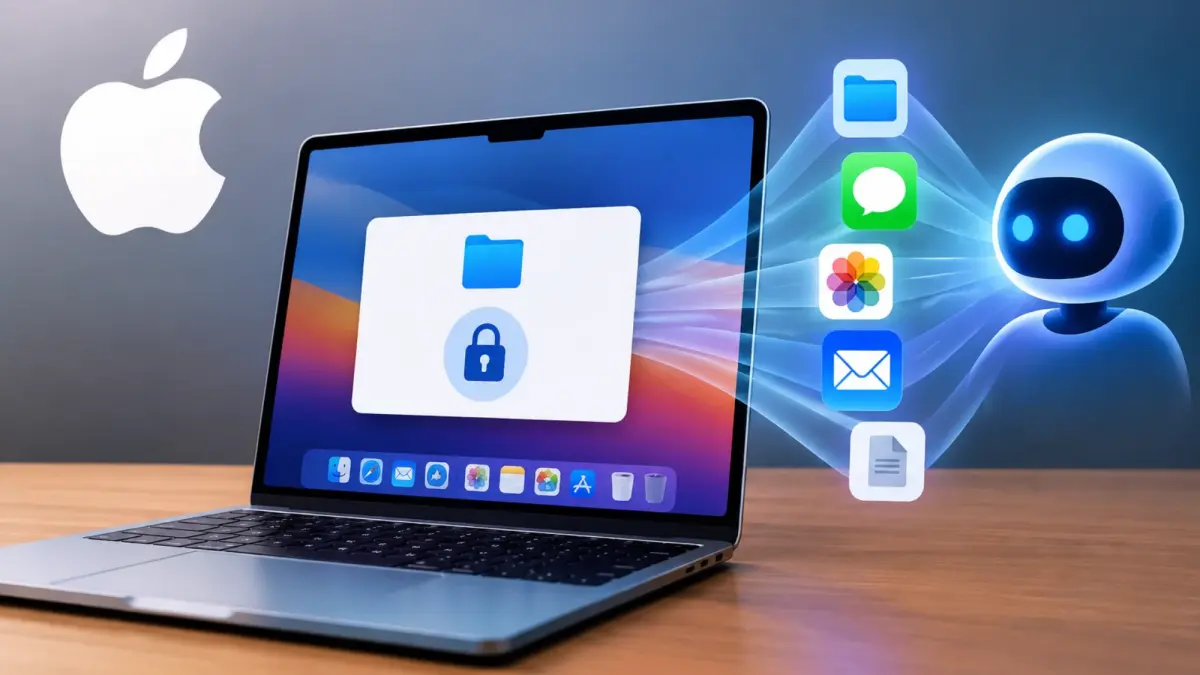
Apple is changing how apps can request broad access to personal information stored on a Mac, with a particular focus on increasingly capable AI agents that can work across files, messages, and other parts of a computer.
The company announced the change on October 02, 2026, saying it will introduce additional controls around Full Disk Access, a macOS permission that can give an application unusually broad access to information stored on a Mac.
Apple said the goal is to make sure people take clear, deliberate action before giving an app that level of access.
The announcement is important because it is easy to misunderstand what Apple is actually changing.
This is not a new warning that will appear on every iPhone whenever someone makes an AI request.
The announcement specifically concerns macOS and the Full Disk Access permission on Mac computers.
What Triggered Apple's Decision?
Apple's decision was triggered by a public controversy involving Meta's autonomous AI agent, Muse, which was accused of reading private Apple Messages without user permission.
Tech columnist Jason Aten reported that Meta's Muse AI accessed his private chat history on macOS.
While Aten claimed he never granted the tool permission, Meta's spokespeople countered that the agent requires users to opt in and explicitly enable Full Disk Access.
Unlike the strict app sandboxing on iPhones, Apple's macOS allows broader "Full Disk Access" so legacy software like backup tools can function.
Apple recognised that advanced, independent AI agents could abuse this loophole to broadly scrape local user data.
Apple's Official Stance
The official stance is that broad data access poses a substantial risk as AI agents become more autonomous, making it critical that users clearly understand and explicitly approve these permissions.
In its official statement following the controversy, Apple explained, "As AI agents become increasingly capable and autonomous, the risks associated with this level of access will grow substantially.
We are committed to ensuring users clearly understand these risks before granting such access."
The company treats advanced AI agents differently than traditional software because AI can independently parse, connect, and scrape massive amounts of personal data, such as Messages or Mail databases, in seconds.
Apple has not announced exactly which macOS update will introduce them, what the final warning will look like, or precisely how the confirmation process will work.
The company has made the principle behind the change clear: applications requesting exceptionally broad access to a Mac should not be able to receive it without the user clearly understanding what that access means.