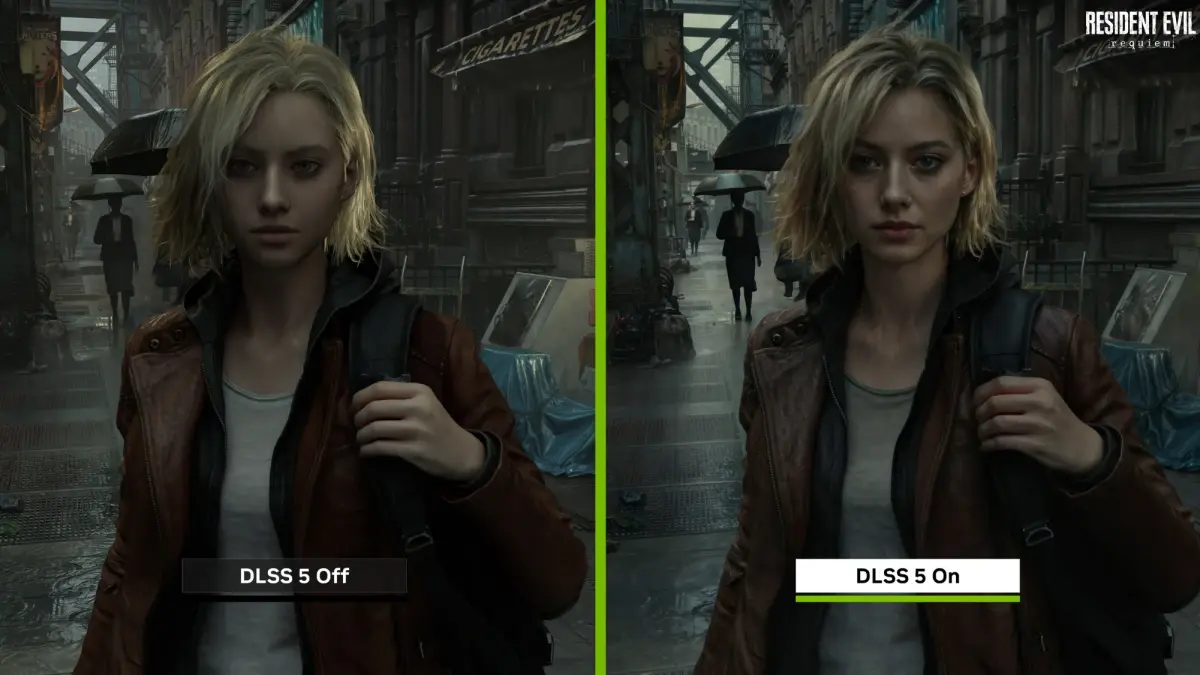
The world of PC gaming is standing on the edge of a total transformation. Yesterday at GTC 2026, NVIDIA CEO Jensen Huang officially unveiled DLSS 5, describing it as the "GPT moment for graphics."
This isn't just a small update to boost your frames; it is a revolutionary AI model designed to "paint" photorealistic textures and lighting onto games in real time, bridging the gap between digital animation and Hollywood-grade visual effects.
The Magic Under the Hood: Real-Time Neural Rendering
While previous versions focused on upscaling (DLSS 2) or creating extra frames (DLSS 3 & 4), DLSS 5 introduces Real-Time Neural Rendering.
How it works: The AI takes a game's raw data, colours, and motion vectors and uses a massive neural network to "re-render" the scene. It understands "semantics," meaning it knows the difference between human skin, silk fabric, and metallic surfaces.
The Result: It applies realistic light scattering to skin, a delicate sheen to hair, and perfect shadows to complex objects like foliage. By doing this, it aims to eliminate the "uncanny valley," where digital characters look almost human but feel slightly "creepy" or "off."
Arrival and Game Line-up
NVIDIA has confirmed that DLSS 5 is targeting a Fall 2026 launch. Industry giants, including Bethesda, Capcom, Ubisoft, and Warner Bros. Games, already back the tech. Some of the massive titles confirmed to support the feature at launch include:
How to Use It
Gamers won't need a PhD in AI to use this. Once it arrives:
NVIDIA App Update: Ensure your NVIDIA App and Game Ready Drivers are updated to the Fall 2026 release.
In-Game Menu: In supported titles, look under the "Graphics" or "Video" settings.
The Toggle: You will find a new option alongside Super Resolution and Frame Generation labelled "Neural Rendering" or "DLSS 5."
Artistic Control: Interestingly, developers can "mask" certain areas, keeping the game's unique art style while applying photorealistic AI only to faces or specific materials.
Hardware Requirements: The Power Cost
During the live demo, NVIDIA showcased the tech running on a high-end system with dual RTX 5090 GPUs, one dedicated to gaming and the other to running the DLSS 5 AI model.
However, Jensen Huang assured the audience that by the time the software officially ships this fall, it will be optimised to run on a single RTX 50-series (Blackwell) GPU. There is currently no word on whether older cards (like the 30 or 40 series) will be compatible, as the tech relies heavily on fifth-generation Tensor Cores.
"We are reinventing computer graphics once again," Huang stated. "DLSS 5 blends handcrafted worlds with generative AI to deliver a leap in realism we haven't seen since the debut of ray tracing."