Artificial Intelligence is steadily becoming a part of everyday life, helping people write emails, learn new skills, generate code, and even solve complex problems.
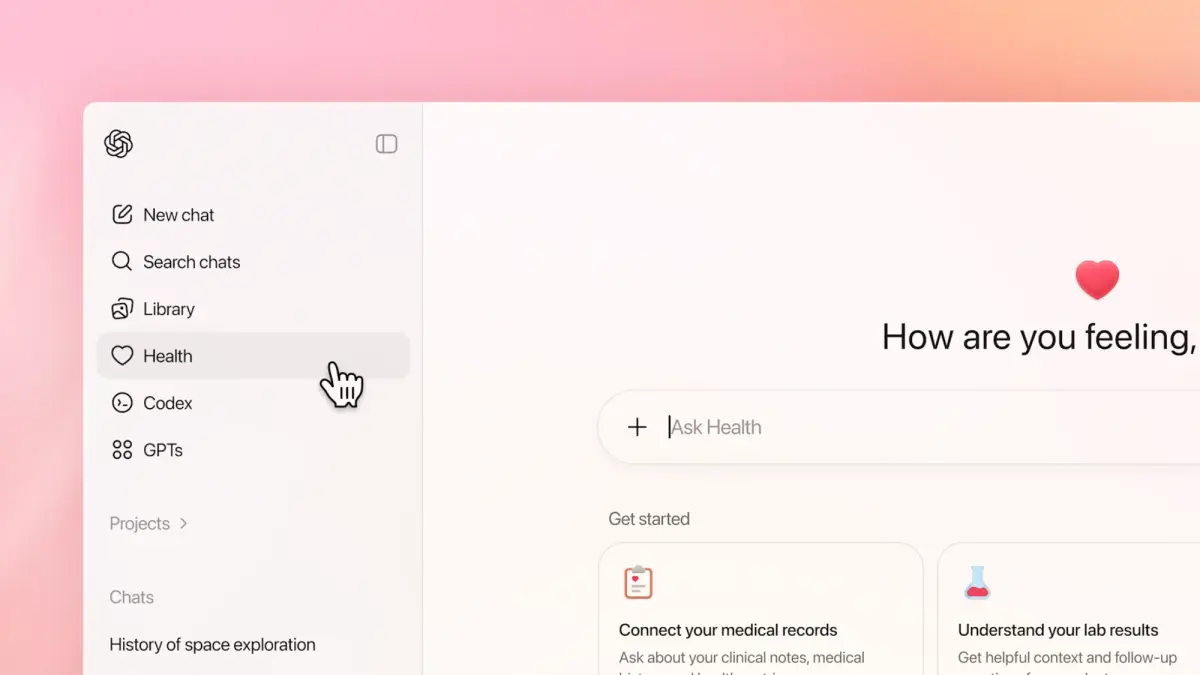
Now, OpenAI is taking the biggest step: bringing AI into healthcare by launching Health in ChatGPT, a feature designed to understand and manage users' personal health information.
While OpenAI has highlighted that this feature is not a replacement for doctors or medical professionals, it aims to make healthcare information much easier to understand, more accessible and more actionable.
Why Did OpenAI Launch A Health Feature?
The healthcare sector is one of the industries that relies heavily on information.
Patients often receive medical reports filled with complex terminology, laboratory values, prescriptions, and discharge summaries that are too difficult for non-medical professionals to understand.
OpenAI introduced this feature to serve severe critical needs.
Users can connect their electronic medical records from hospitals like Epic, Oracle Health and One Medical, alongside fitness data from Apple Health and MyFitnessPal.
It eliminates the need for users to repeatedly upload or manually explain their medical history during different chat sessions.
OpenAI reported that 300 million people globally ask health and wellness questions every week.
Early testing showed that 70% of health-related questions happened naturally during everyday chats.
Integrating this into the main chat window eradicates the need to open a separate app or tab.
By developing specialised foundational medical models (such as GPT-5.6 Sol), the feature is designed to analyse intricate medical data thoughtfully, identify urgent care situations, and clearly articulate areas of uncertainty.
It translates technical lab results into simple terms, helping patients track long-term patterns and prepare better questions for their doctors.
Standard ChatGPT interactions can sometimes be used for model training. ChatGPT Health was built to fulfil a crucial and ethical need.
It creates an encrypted, isolated space where personal medical information is strictly protected and never used to train OpenAI's models.
How Is This Different From Searching On Google?
Many users search Google when they have a medical question, but Google provides them with dozens of websites.
This may lead to confusion instead of providing a clear answer to their medical inquiry.
Whereas ChatGPT provides conversational explanations tailored to the user's question and uses connected data from their own health information.
Instead of manually comparing reports, it can explain trends, identify changes and suggest topics to discuss with a healthcare professional.
This makes the interaction more personalised than traditional web search.
Why Is This Feature Available Only in the United States?
The ChatGPT Health feature, specifically its integration with medical records and third-party apps, is limited to the United States due to structural, technical, and regulatory differences in global healthcare systems.
U.S. healthcare providers largely operate on a unified data standard called FHIR (Fast Healthcare Interoperability Resources).
This allows OpenAI's network partner, b.well, to connect to over 2.2 million providers and 320 health plans simultaneously.
The European Union and the UK govern medical data under strict frameworks like the General Data Protection Regulation (GDPR).
These laws treat biometric and health data with extreme sensitivity, requiring stringent local data residency and compliance audits before a feature like this can launch.
At launch, OpenAI explicitly excluded the European Economic Area (EEA), Switzerland, and the United Kingdom from the rollout to avoid premature legal conflicts as it navigates these strict data-sharing boundaries.
The initial health integrations rely heavily on platforms deeply rooted in the U.S. market, such as Function Health, MyFitnessPal, and localised instantiations of Apple Health.
Replicating these ecosystems internationally requires separate corporate partnerships in every new region.
Challenges And Limitations
Despite its promise, AI-powered healthcare assistance still faces important challenges.
Users should remember:
AI responses can contain mistakes.
Symptoms often require professional evaluation.
Emergencies should never rely on chatbot advice.
Medical decisions should always be confirmed with qualified healthcare providers.
Healthcare experts also continue to study issues surrounding bias, accuracy, transparency, and accountability in medical AI systems.
The introduction of Health in ChatGPT marks one of OpenAI's most ambitious product launches to date.
However, global users will have to wait; the launch offers a glimpse into how AI could become an integral part of everyday healthcare in the coming years.