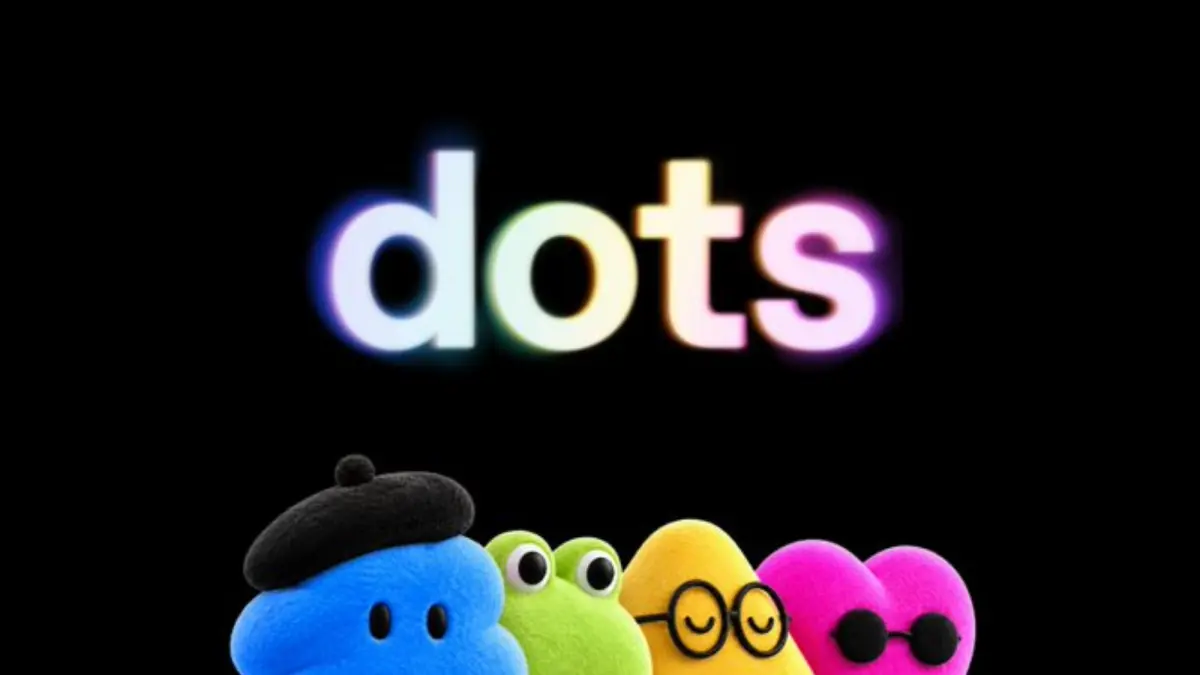
OpenAI has introduced Dots, a new kind of digital agent designed to keep working after a user finishes giving instructions.
Instead of waiting for a new question each time, Dots pursue a goal, work through tasks in the background, and return when something important needs to be shown, asked, or approved.
The company unveiled Dots on September 29, 2026, during its annual DevDay event in San Francisco.
The announcement comes as the technology industry shifts from assistants that mainly answer questions to systems that can carry out multi-step work.
OpenAI is entering that competition alongside companies such as Meta, Anthropic and Google.
Core Capabilities
Dots operate without constant, step-by-step prompting.
After a user delegates a long-term goal or operational responsibility, the assistant works continuously in the background, remaining active even if the user goes offline or powers down the device.
Every Dot operates within a dedicated cloud infrastructure, equipped with a virtual computer and web browser.
A live virtual screen remains accessible at any time, so you can monitor the assistant browsing, clicking, and completing tasks in real time.
While Dots run in the cloud, secure permissions allow them to connect directly to a physical Mac or Windows laptop.
This enables interaction with the local environment and direct assistance on the workstation.
Dots connect to and orchestrate workflows across more than 4,000 applications, natively interacting with tools such as Slack, Microsoft Teams, GitHub, Google Drive and Gmail.
The Underlying Models Of Dots
GPT-6 Astra - The Core Flagship Brain
Every Dot is primarily driven by GPT-6 Astra, OpenAI's frontier intelligence architecture.
This acts as the heavy-duty cognitive foundation that gives the Dots their advanced reasoning capabilities, allowing them to plan complex, multi-step tasks, navigate the web autonomously, and write code.
GPT-6.1 Sol - The Optimised Workplace Assistant
Alongside Astra, OpenAI introduced GPT-6.1 Sol.
While Astra handles the most complex, high-level reasoning, Sol is optimised as a fast, highly affordable daily workhorse for heavy data processing, programming tasks, and standard workplace logic at a fraction of the cost.
GPT-6 Astra "Ultrafast" Mode
For tasks requiring instantaneous reaction time, such as continuous background monitoring or lightning-fast API automation, Dots uses a specialised Ultrafast speed-boosted configuration.
This variant optimises token execution speed so the agent can make rapid, structured decisions via OpenAI's new Decisions.
Codex - The Sandbox OS Environment
Dots don't just use language models; they are deeply tied to Codex, which operates entirely in the cloud.
Codex provides an isolated virtual machine and cloud operating system that lets a Dot execute code, host its own browser instance, and handle complex file transitions across the device seamlessly.
Rollout Details
ChatGPT Pro, Business Premium, and Enterprise subscribers are eligible to use OpenAI's Dots, and they currently receive access to one personalised Dot that they can name, style, and assign to background workflows.
Eligible plans include the first Dot at no additional cost.
Who Is Currently Excluded?
The Dots feature is unavailable to users on the standard Free or ChatGPT Plus tiers.
Additionally, individual Pro subscribers in the UK, Switzerland, and the European Union cannot access the feature at launch due to local regulatory frameworks, and it is strictly restricted to adult users aged 18 and older.
Platform Setup Requirements
Even if an account is eligible, users must create and set up a Dot via the ChatGPT desktop app or a desktop web browser.
Once created, users can interact with the Dot on desktop and in the ChatGPT mobile app.
Dot marks an important step in OpenAI's product strategy.
It takes the company's conversational technology and puts it into a system designed to keep working after the conversation ends.