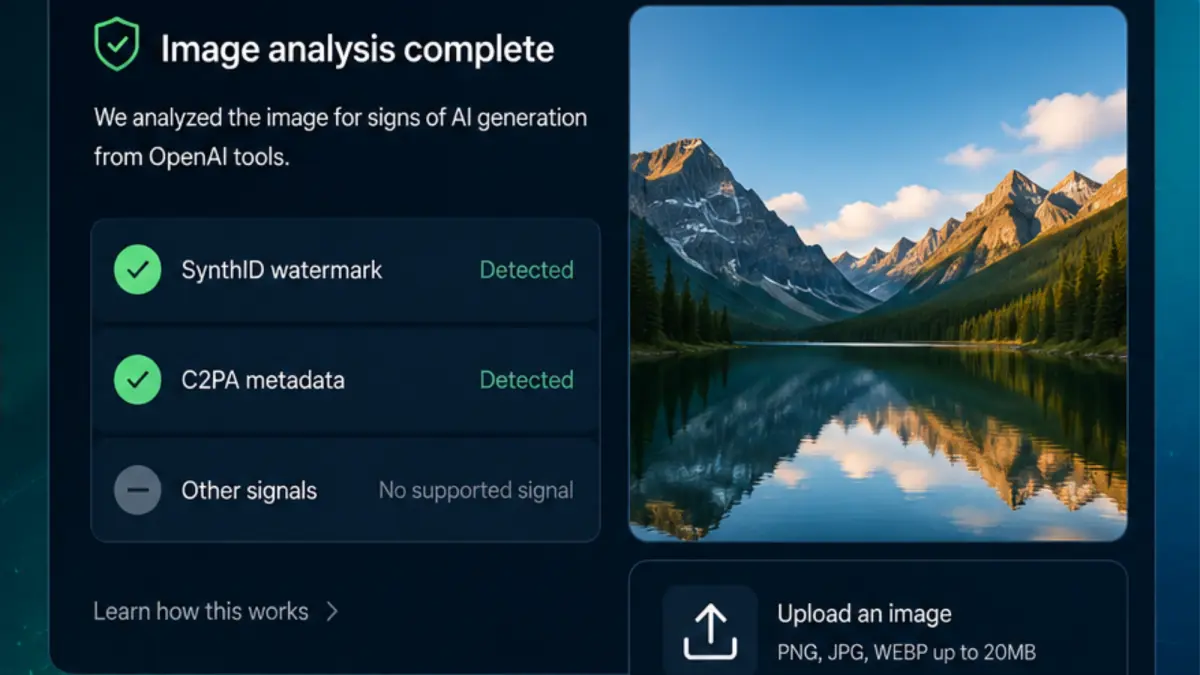
As AI-generated images become more realistic and harder to distinguish from authentic visuals, OpenAI has introduced new measures to reduce misinformation caused by deepfakes.
The makers of ChatGPT recently announced a free public image verification tool and a partnership with Google to strengthen transparency around AI-generated content.
OpenAI Integrates SynthID Watermarking
On May 19, OpenAI announced it is integrating SynthID, an invisible watermark developed by Google DeepMind, into visuals generated by its AI systems. Alongside this, the company launched a public verification platform that helps users determine whether an image was created using OpenAI's tools.
The verification system checks for two key signals: SynthID and C2PA metadata. While SynthID embeds an invisible watermark in images, the C2PA standard adds metadata indicating whether content was generated or edited using AI.
According to OpenAI, the tool is currently focused on detecting images created through ChatGPT, the OpenAI API, and Codex, with plans to support additional AI platforms in the future.
Why This Matters?
The move comes as AI image generators continue to advance rapidly, making manipulated visuals more convincing and widely accessible online. OpenAI believes combining watermarking with metadata could offer a more reliable way to trace the origins of digital content.
The company explained that while metadata can provide useful details about an image's source, it may be altered or removed. SynthID, however, was designed to remain detectable even after screenshots, resizing, or editing attempts, making it more resistant to tampering.
How to Use the Verification Tool?
To use the new verification tool, users need to upload a single image in supported formats such as PNG, JPG, or WEBP. The system then scans the file to determine whether it contains C2PA metadata, a SynthID watermark, or no supported signal.
For better accuracy, OpenAI recommends uploading original, uncropped images and avoiding screenshots with multiple visuals. Heavily edited files or tightly cropped images may reduce the tool's ability to detect AI-related signals.
OpenAI noted that even if no evidence is found, it does not necessarily mean an image was not AI-generated. In some cases, users may receive a response stating that there is no proof that the content was created with OpenAI tools, even though it may have originated from another AI system.
Industry Standards and Future Impact
The Coalition for Content Provenance and Authenticity (C2PA), a nonprofit founded in 2021, has played a major role in promoting standards for identifying AI-generated content. Although several major tech companies have adopted the framework, industry-wide implementation remains inconsistent.
By combining durable watermarking with metadata-based verification, OpenAI hopes its latest efforts will help improve trust in online content and slow the spread of misleading AI-generated imagery.