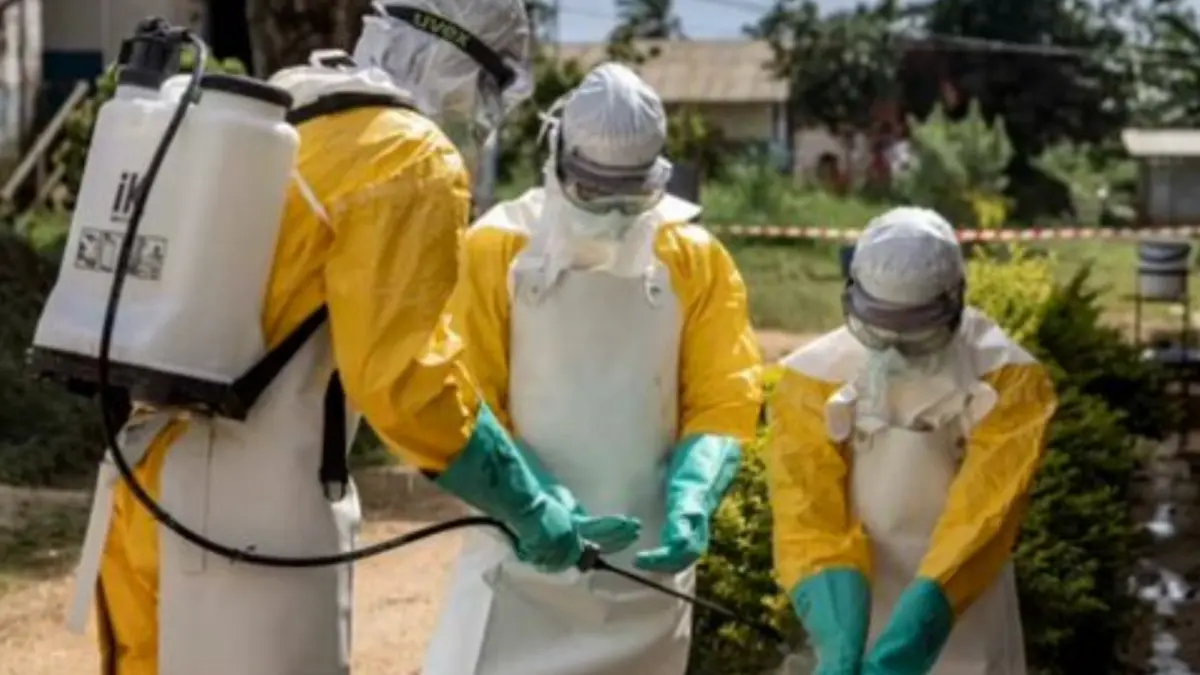
Kenya has confirmed its first case of Ebola virus disease after a Kenyan citizen who had been living in the Democratic Republic of Congo (DRC) became seriously ill and later died at a hospital in Nairobi.
Health Cabinet Secretary Aden Duale announced the case on October 6, 2026.
Key Details Of The Case
He developed Ebola symptoms while still in the DRC roughly a month before travelling.
He travelled by road from the DRC through Uganda to Kampala.
He then boarded a flight from Entebbe and landed at Jomo Kenyatta International Airport (JKIA) in Nairobi on October 3, 2026.
Upon arriving in Nairobi, he passed through routine public health screening and immigration desks without being flagged.
Once he arrived at the hospital, the admission and isolation process moved quickly.
Because he was presenting with severe symptoms including a fever, intense fatigue, painful swallowing and visible bleeding under the skin at a prior injection site, doctors immediately grew suspicious of a viral hemorrhagic fever based on his travel history.
They first placed him in a separate, isolated room within the Accident and Emergency area to limit public exposure.
Then they moved him to the hospital's East Wing isolation facility.
This specialised unit was originally built during the COVID-19 pandemic and is heavily equipped with intensive care and high dependency units designed to handle highly infectious diseases.
It was within this isolation facility that medical staff drew the blood samples that ultimately confirmed he had the Ebola Bundibugyo virus.
The patient died late on the night of Monday, October 5, 2026.
No vaccines or targeted antiviral therapies are currently approved for the Bundibugyo strain, unlike the more common Zaire strain.
Health authorities are conducting a safe, dignified burial on Tuesday under strict infectious disease protocols.
Public Health Response And Surveillance
After confirming Kenya's first imported Ebola case, the Ministry of Health immediately activated its National Ebola Incident Management System to implement aggressive containment, contact tracing, and border surveillance measures.
Contact Tracing
Health officials have identified and isolated 28 primary contacts.
This group includes the patient's family members, friends, and the medical workers at Nairobi Hospital who first attended to him.
The government is actively tracking 23 passengers and 4 crew members who were on the same Jambojet flight from Entebbe to Nairobi.
Dedicated quarantine sites have been fully prepped and activated to hold any individuals considered at high risk.
Border Surveillance And Testing
Surveillance teams have heightened operations at all 26 formal points of entry.
As of October 6, 2026, a total of 652,584 travellers have been screened since heightened preparedness began in May.
To speed up turnaround times for cross-border travellers, the government has deployed two specialised mobile laboratories directly to the high-risk western and northern borders at the Busia and Lwakhakha border crossings in Bungoma.
Kenya has designated five centralised national reference laboratories, including the Kenya Medical Research Institute (KEMRI) and the National Virology Reference Laboratory, running around the clock to process blood samples.
Before this case, 267 samples had already been tested nationwide, all previously returning negative.
Healthcare Worker Preparedness
Over the past few months, 4,971 healthcare workers at both the national and county levels have undergone rigorous training in Ebola containment, symptom detection, and safe case management.
In compliance with the International Health Regulations, Kenya has formally notified the World Health Organisation (WHO) of the imported case and coordinated regional border health strategies with Uganda and the DRC.
Health CS Aden Duale has advised the public to remain calm, avoid spreading misinformation, practice strict hand hygiene using alcohol-based rubs and report anyone presenting with an acute fever, particularly individuals arriving from regional transit zones within the past three weeks.
For Kenyan health authorities, the most important task now is to determine whether the virus travelled any further.
At the same time, confirming only one positive sample among hundreds of tests provides an important piece of information: the Kenyan testing data cited by the Ministry shows no evidence of a widespread Ebola outbreak.