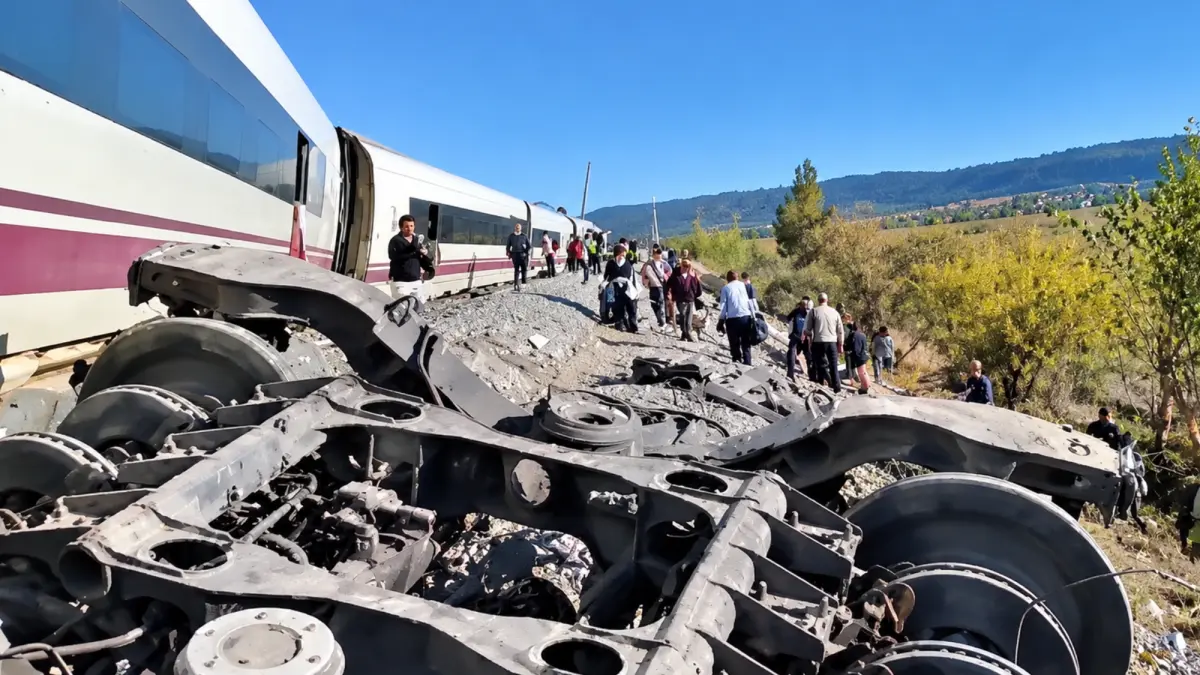
Two high-speed trains collided in Toledo, Spain, at 9.00 a.m. local time, causing a major disaster. It resulted in at least 68 people being killed and several being injured.
Details on the high-speed trains and accident occurrence
The collision occurred on Wednesday, October 28, and involved a train operated by Spain's state-owned Renfe railway company and another operated by private rail company Iryo.
Both trains were travelling on the Madrid-Seville route. The impact happened on a stretch of track located between the municipalities of Mora, Orgaz, and Urda.
Esther Padilla, the spokesperson for the Castilla-La Mancha region, said 397 passengers were on the Renfe train and 147 on the Iryo train.
The high-speed trains collided shortly before 9:15 a.m. local time (4:15 a.m. ET), when emergency services were deployed to the scene. The collision occurred on the Madrid to Seville line, where one train hit a stationary vehicle at over 100 kilometres per hour (62 miles per hour).
Deaths and injuries details
While the official death toll initially stood at 10, emergency services and Spanish media outlets have confirmed that at least 30 to 68 people have died.
Dozens of the 544 total passengers on board have sustained injuries. Rescuers are actively treating passengers at the crash site and utilising a sports pavilion in nearby Urda as a triage centre.
Spanish Prime Minister's Response towards the disaster
After the incident, Pedro Sanchez, Spain's Prime Minister, shared an X post expressing his shock at the collision. The post says, "Shocked by the serious train accident in Toledo. I remain in constant contact with the Minister of Transport and with the president of Castilla-La Mancha."
Spanish PM further wrote that "Emergency services are working on the ground to assist those affected and ensure their safety, in coordination with all the involved administrations. My affection, solidarity, and support to all the victims and their families."
This impacted train transport on specific routes in Spain. It resulted in suspended services on the affected high-speed railway corridor connecting Madrid, Ciudad Real and Andalusia.
Emergency responders, including firefighters and medical teams, were dispatched to the site to assist injured passengers and rescue those trapped in the damaged carriages. Local authorities have also arranged support for passengers affected by the crash.
Authorities have warned that the death toll could rise as rescue operations continue. The cause of the collision has not yet been officially established, and further investigations are expected to determine the circumstances.
The crash has raised renewed concerns about railway safety in Spain, which experienced another deadly high-speed train accident earlier this year.
Authorities are expected to release further details about the victims, the number of injured passengers, and the circumstances leading to the collision as they continue their investigation.
History of high-speed train accidents in Spain
Spain's rail system operator, ADIF, said the crash occurred in the morning in the province of Toledo. The accident sent shockwaves, as it is not the first such incident this year.
This marks the second disastrous event on Spain's high-speed network this year, following a derailment and subsequent collision in Adamuz back in January that claimed 45 lives.
It marks the deadliest accident since a 2013 crash that killed 80 people. The January incident shook the European country's confidence in its extensive high-speed rail network.