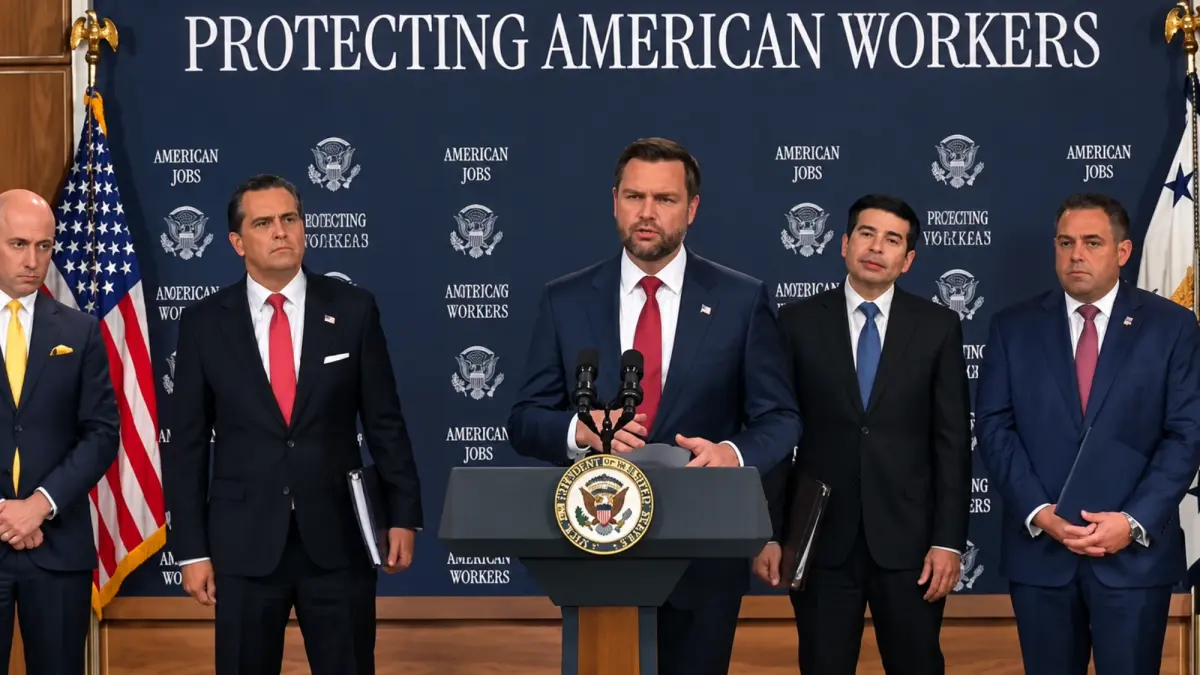
The United States has suspended eight major technology and IT services companies from a key employment-based green card program, creating fresh uncertainty for thousands of skilled foreign professionals hoping to build long-term careers in the country.
The Trump administration announced the decision on October 8, 2026, affecting companies including Microsoft, Adobe, Infosys, Tata Consultancy Services (TCS), Wipro, HCL Technologies, Cognizant, and Capgemini.
The action targets the Permanent Labour Certification programme, commonly known as PERM, which allows eligible employers to sponsor foreign workers for permanent residency in the United States.
The US government says the move is intended to address suspected immigration fraud and protect American workers from unfair competition.
However, the decision has raised concerns among Indian IT professionals, particularly those working in the US on H-1B visas and waiting for their employment-based green card applications to progress.
Reasons For The Suspension
Labour Secretary Keith Sonderling said the suspension was triggered by multiple ongoing federal investigations into the targeted firms over visa fraud and systematic abuse of the employment-based immigration pipeline.
Vice President JD Vance explicitly singled out Microsoft, accusing the company of laying off 6,000 American workers in 2025 while simultaneously obtaining approval for over 6,000 H-1B visas and submitting over 3,600 PERM permanent residency applications.
The administration argued that the company was actively replacing laid-off US workers with lower-paid foreign staff.
The administration alleged that these companies exploit loopholes to bypass requirements meant to protect local talent.
Vance said companies would post hidden or obscure ads, such as in small-town newspapers, to claim they couldn't find qualified local applicants, then use the lack of response to justify hiring what he called "foreign indentured servants" from "visa mills".
Federal officials stated that since 2009, these eight companies alone had requested nearly 3 million foreign workers and secured over 100,000 green card certifications.
The administration explicitly framed the freeze as a measure to put American workers first and stop foreign programmes from taking away hundreds of thousands of local job opportunities.
Impact On Indian Professionals And H-1B Holders
The green card PERM suspension immediately freezes the permanent residency pipeline for affected workers but does not cancel existing H-1B visas.
Because Indian nationals account for over 70% of all approved H-1B visa petitions annually, they bear the brunt of this policy change.
Affected workers cannot start new PERM applications or move pending petitions forward with these eight employers.
While they can legally continue working on their current H-1B visas, their path to transitioning to a green card is completely blocked at these firms.
The Department of Labour's suspension strictly targets the Permanent Labour Certifications process.
It does not automatically cancel or invalidate existing, approved H-1B visas.
H-1B visas are generally capped at six years.
Normally, workers can extend their H-1B status past six years if they have an approved I-140 petition or a PERM application pending for more than 365 days.
With PERM applications frozen or rejected, workers approaching their six-year limit risk running out of time to legally extend their status, forcing them to either change employers or leave the country.
Under AC21, H-1B holders with a long-pending I-485 adjustment application can change jobs freely.
However, those whose PERM applications are now frozen cannot reach this stage of job flexibility, effectively tying them to their current situation unless they find a non-suspended employer willing to restart their entire green card process from scratch.
Many professionals will face prolonged career stagnation, as taking a promotion or changing roles internally often requires filing an updated PERM application, which these eight companies are currently prohibited from doing.
Microsoft's Defence: "Not New Arrivals"
Microsoft issued a detailed public statement strongly rejecting the notion that it is using the visa system to displace American talent.
The company noted that 80% of the approximately 6,000 H-1B visa applications it submitted in the last fiscal year were filed to extend or change the status of existing employees already legally working within the US.
The remaining filings for new employees were for individuals already residing in the country and represented only 1% of the total US workforce.
Microsoft emphasises that it pays some of the highest compensation in the tech sector, matching wages identically between H-1B holders and US workers doing comparable work to ensure no wage undercutting.
Tata Consultancy Services: "No Material Impact"
In an exchange filing, India's top IT exporter, TCS, said it will comply with the Department of Labour directives but expects no material impact on its workforce strategy or client engagements.
TCS states that its US operations are heavily anchored in hiring local talent through robust campus recruitment models.
The company added that its actual PERM filings have historically been minimal, and it intends to stick to its target of adding 15,000 local US hires over the next five years.
NASCOM (IT Industry Body): "A Limited Immigration Pathway"
The National Association of Software and Services Companies (NASCOM), which represents major Indian IT outsourcing firms like Infosys, Wipro, and HCLTech, stepped in to defend the industry.
NASCOM argued that the H-1B visa program is primarily used by its members to address short-term skill and talent gaps in the US market rather than as a permanent pipeline.
The industry body noted that Indian tech firms have sharply cut their dependence on H-1B visas in recent years, making the transition from H-1B to green cards relatively limited for their overall business models.
The administration has linked the decision to ongoing investigations and concerns about the use of foreign worker programmes.
However, further details are needed to establish how the restriction will be implemented and what options may be available to affected employers and employees.
The outcome will matter not only to Indian professionals but also to US businesses that employ international talent.
A prolonged restriction could affect hiring strategies, workforce mobility, and skilled foreign workers' willingness to build long-term careers in the United States.